
Industry Standard – Composites – ASTM D7264

This test method determines the flexural stiffness and strength properties of polymer matrix composites.

Bending tests are used to determine important mechanical properties. In the test, the lower half of the laminate is subjected to tensile loads, and the upper half to compressive loads. The load is zero in the mid-plane of the laminate. Furthermore, in-plane shear is generated during bending tests; therefore, the ratio of the specimen span to its thickness should be as large as possible to minimize the impact of shear stress.

For multidirectional laminates, bending tests can detect layup errors, which is very helpful for production quality control and incoming material inspection.

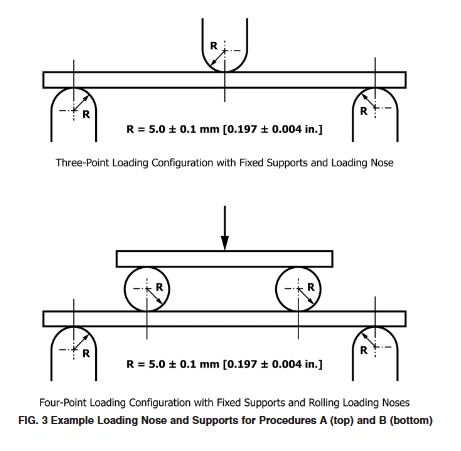
Three-Point Bending Test

The three-point bending test for composite materials is very common and easy to perform.

The flexural modulus is determined at 10% to 50% of the maximum test force (EN 2562), or 10% to 25% of the maximum test force (EN 2746), or between the two stress limits (ISO and ASTM standards).

ASTM standards specify a span-to-thickness ratio of 32:1.

ISO standards specify 20:1 for GFRP and 40:1 for CFRP;

EN standards specify 16:1 for GFRP and 40:1 for CFRP.

This ensures the specimen withstands the lowest possible shear load.

Four-Point Bending Test

The advantage of the 4-point bending test for composite materials lies in the shear-free region between the two indentation points.

The flexural modulus is measured using 0.05% to 0.25% strain (ISO 14125) or 0.1% to 0.3% strain (ASTM D7264).

The central support span can be 1/3 (ISO 14125) or 1/2 (ASTM D7264) of the lower support span. The span to thickness ratio is 32:1 in ASTM. ISO uses 22.5:1 for GFRP and 40.5:1 for CFRP.

The standard requires deflection to be measured directly at the midpoint of the supports.http://www.camcjsw-testmachines.com/wp-content/uploads/2026/04/98fd72ca4f3de6c5c6f0264627dea425.webp
Leave a Comment

Your email address will not be published. Required fields are marked *

en_USEnglish