
Hydraulic Power Unit
Home>>Accessories>>Hydraulic Power Unit
Hydraulic Power Unit

The SY series servo hydraulic station(HPU) is a mechanical device that provides power for the electro-hydraulic servo fatigue testing system. It has the characteristics of simple structure, stable working pressure, energy saving and environmental protection, and is widely used in various types of electro-hydraulic servo fatigue testing machines. We can provide hydraulic system solutions according to customer needs.
Features:
- Adopting a fully enclosed pure aluminum metal structure, corrosion-resistant; Easy to maintain;
- Adopting Siemens motor, Voith meshing gear pump, and flexible coupling connection, the pressure is stable, the pulse is small, the efficiency is high, and the service life is long.
- The oil pump is located inside the oil tank, with low noise. The motor is inverted above the oil tank, occupying a small area;
Adopting brazed plate heat exchanger, with high heat transfer coefficient and good cooling effect;
A control system composed of well-known electrical components such as Siemens;
Design liquid level, temperature monitoring and protection functions;International standard matching connector, the connector complies with DIN2353 standard; Adopting a three-stage filtration device to ensure the cleanliness of the hydraulic system; A stable valve controlled hydraulic system with stable and reliable pressure and flow.
Parameters:
- Rated pressure: 21/28MPa
- Rated flow: 36-540L/min
- Max. capacity: 3000L/min-28MPa
Application


Hydraulic Service Manifold
The FYQ series Hydraulic Service Manifold(HSM) is an auxiliary mechanical device that provides power for electro-hydraulic servo systems. It adopts a structure of one main body and multiple sub bodies, which can achieve up to one to four, and each channel can be independently controlled. It has the characteristics of simple construction, small space occupation, and stable working pressure, and is widely used in various types of electro-hydraulic servo systems. We can provide hydraulic system solutions according to customer needs.
Features:
- It can be remotely started and stopped.
It can be used for both high and low voltage models, with high and low voltage switching functions and adjustable low voltage.
Low pressure to high pressure soft start can be performed, and the pressure can be smoothly switched. The low pressure to high pressure switching time is 3-6 seconds.
- The accumulator plays a role in replenishing energy and absorbing vibrations.
- The filter serves as a secondary filter to protect the actuator, with a filter element of 10 microns.
- Each channel on each HSM can achieve independent control.
Parameters:
- Rated pressure: 21/28MPa
- Rated flow: 200-600L/min
- Max. capacity: 900L/min-28MPa(630+250)
Application


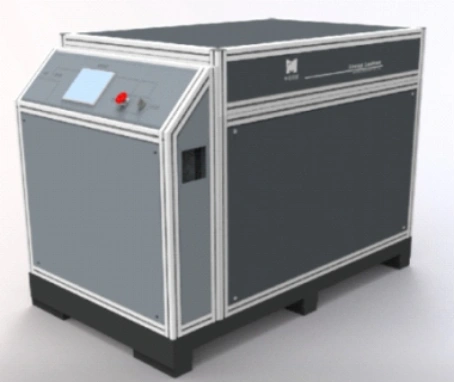
Mute hydraulic power unit
This series HPUs are specially designed for electro-hydraulic servo structure testing system and are of high quality and specially designed for laboratory after mute treatment. The mute HPU can effectively control the noise and is a better choice for universities or some enterprises that cannot establish sound insulation measures.
Characteristic
1、in the form of oil-immersed pump group, effectively reduce the noise at the sound source;
2、The detachable sound insulation shell is adopted,which not only can effectively reduce the noise in the transmission process, but also is convenient for maintenance and cleaning; And the hydraulic oil does not cool during shut down, thus shortening or eliminating the preheating process when restarting the equipment;
3、The pump unit is installed in the oil tank through the shock absorption design assembly and connected to the outside through the hose to reduce the vibration interference to the external structure.
4、inherited most of the advantages of common servo hydraulic station.
Detailed Technical Specification
Model | Rated pressure | Rated flow | Rated power | Remarks |
SY40/60/100-21 | 21MPa | 36/54/90L/min | 15/22/37kW | Aluminum alloy fuel tank (Optional:remote control) |
SY200-21/28 | 21/28MPa | 180L/min | 74/90kW | Aluminum alloy oil tank (Optional: stainless steel oil tank/remote control) |
SY300-21/28 | 21/28MPa | 270L/min | 111/135kW | Aluminum alloy oil tank (Optional: stainless steel oil tank/remote control) |
SY400-21/28 | 21/28MPa | 360L/min | 148/180kW | Aluminum alloy oil tank (Optional: stainless steel oil tank/remote control) |
SY500-21/28 | 21/28MPa | 450L/min | 185/225kW | Aluminum alloy oil tank (Optional: stainless steel oil tank/remote control) |
SY600-21/28 | 21/28MPa | 540L/min | 222/270kW | Aluminum alloy oil tank (Optional: stainless steel oil tank/remote control) |
Model | Rated pressure | Rated flow | Single-channel flow | Remarks |
FYQ200-21/28-2 | 21/28MPa | 200L/min | 100L/min | Remote start stop(Optional: individual control/soft start) |
FYQ300-21/28-2/3 | 21/28MPa | 300L/min | 150/100L/min | Remote start stop(Optional: individual control/soft start) |
FYQ400-21/28-2/4 | 21/28MPa | 400L/min | 200/100L/min | Remote start stop(Optional: individual control/soft start) |
FYQ500-21/28-1/2 | 21/28MPa | 500L/min | 500/250L/min | Remote start stop(Optional: individual control/soft start) |
FYQ600-21/28-2/3/4 | 21/28MPa | 600L/min | 150/200/300L/min | Remote start stop(Optional: individual control/soft start) |
▪FOB
▪CIF
▪Package: Wooden case
The history of hydraulic industry development
China’s hydraulic industry started late with a weak foundation. Before the founding of the People’s Republic of China, there was virtually no hydraulic industry in the country, with only minimal use of hydraulic components in fields like press machines and machine tools. After the establishment of the nation, China’s hydraulic sector went through three developmental phases: the foundational entrepreneurship stage, the growth expansion stage, and the rapid development stage. Through years of dedicated efforts, the overall technical capabilities of China’s hydraulic industry have been significantly enhanced.
Foundation and start-up phase
During the foundational and entrepreneurial phase (year 1952-1962), China’s hydraulic industry emerged from scratch by learning Soviet technologies. Initially replicating Soviet-developed hydraulic tooling for lathe applications, Chinese manufacturers gradually established specialized production facilities in the early 1960s to independently manufacture hydraulic components through reverse engineering of existing Soviet designs.
Development and growth stageDuring the development and growth phase (1962-1978), China introduced complete sets of hydraulic technologies and equipment from Japan, gradually combining imported technologies with domestic designs. The number of hydraulic enterprises steadily increased during this period. Throughout this stage, small and medium-sized specialized hydraulic companies emerged across the country, while the application scope of hydraulic components expanded further, progressively covering fields such as machine tools.
Rapid development stageDuring its rapid development phase (since 1978), China actively introduced advanced foreign hydraulic manufacturing technologies to gradually close the gap with global industry standards. The country has established large-scale specialized hydraulic enterprises that have successfully adapted, absorbed, and localized these technologies. Today, China’s hydraulic industry boasts a professional production system with comprehensive product categories, and its applications now span across various sectors including construction machinery, mining equipment, agricultural machinery, sanitation systems, and port operations.
 English
  Spanish
  Russian