
ASTM D3039 is a widely used test standard for determining the tensile properties of composite materials. Composite materials are increasingly favored by the aerospace and automotive industries due to their lightweight properties and high tensile strength, and are being used to replace metals in many applications. Although there are many different types of composite materials, ASTM D3039 applies only to composite materials made of high-modulus fiber-reinforced polymer matrices.
The following characteristic results and values are defined in ASTM D3039:
Tensile stress – force normalized by the initial cross-sectional area of the specimen.
Axial strain – change in gauge length relative to the initial gauge length, measured in the loading direction.
Transverse strain – change in gauge length relative to the initial gauge length, measured in the transverse direction (required only for determining Poisson’s ratio).
Tensile modulus – slope of the stress-strain curve within a specified strain interval in the elastic range. Also known as modulus of elasticity or Young’s modulus.
Tensile strength – maximum tensile stress measured during the tensile test.
Strain at break – axial strain at which the tensile strength is reached.
Poisson’s ratio – The ratio of the change in transverse strain to the change in longitudinal strain between two longitudinal strain points (usually the same as the point used for modulus determination, i.e., 0.1 to 0.3%).
For fiber-reinforced composites that exhibit bi-linear stress-strain behavior, an additional characteristic value may be determined:
Transition strain – mean value of the axial strain in the transition region, typically derived from the axial stress-strain curve.
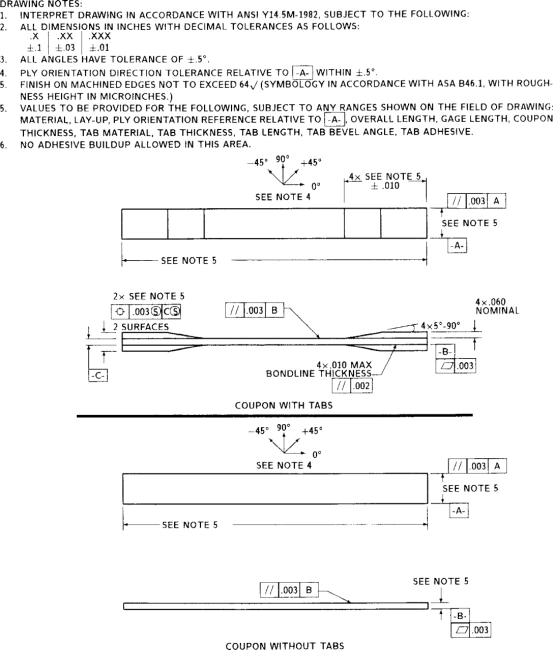
To correctly determine the elastic characteristic values and the strain at break, strain must be measured directly on the specimen. For determining Young’s modulus and strain at break, measuring the axial strain is sufficient. If Poisson’s ratio is also required, a biaxial strain measurement system capable of measuring transverse strain is necessary. Various systems can be used for strain measurement, including strain gauges, sensor-arm measuring systems (e.g., clip-on extensometers — note that these are limited as they cannot be used up to specimen break), automatic sensor-arm extensometers, and non-contact optical systems.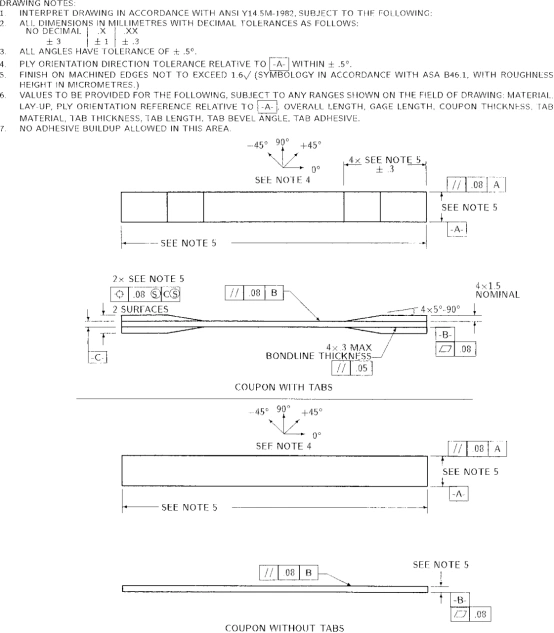
Failure Mode – The fractured specimen must be examined, and its failure type, area, and location must be recorded using a three-character code.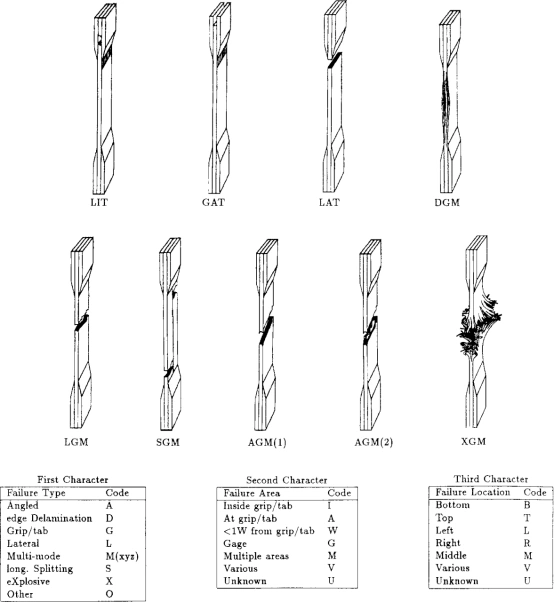
 Russian
  English
  Spanish