
This test method determines the short-beam strength of high-modulus fiber-reinforced composite materials.
The interlaminar shear strength of brittle matrix laminates (such as epoxy resin matrices) is typically determined using the short beam shear test (SBS). The test principle is based on the shear stress generated during bending. If the support span is small relative to the specimen thickness, the shear stress generated during the test is much larger than the bending moment. This property allows shear stress fracture to occur in brittle matrix materials, making it possible to measure the material’s shear strength.
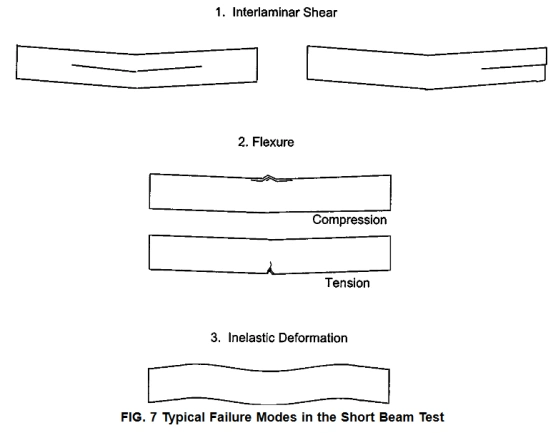
Depending on the failure type, the shear strength of the matrix material or the fiber-matrix bond strength within the material can be characterized.
Short beam shear tests can be performed according to various standards such as ASTM D2344, EN 2563, or EN ISO 14130. The nominal specimen geometry—spare length, width, and support span—is defined relative to the specimen thickness, therefore the specified ratios vary across standards. The diameter specifications of the indenter and supports will also vary for each operating condition.
This test method is relatively easy to implement, requiring only a simple test fixture with good centering capability and a precisely centered indenter. For this reason, this method is commonly used for quality control and is also suitable for comparing the properties of different materials.
However, because compressive stress is usually concentrated above the anvil and affects the measurement results, the above method is only applicable to determining in-plane shear properties.
Specimen and Dimensions for Measuring Interlaminar Shear Strength (ILSS)
Standard Laminate Testing:
In materials development, standard laminates with a thickness of 2 mm are typically tested. Depending on the standard used, the specimen span is 8 or 10 mm, with a tolerance range of ±0.1 mm; EN 2563 requires a very small tolerance range of ±0.02 mm.
Laminate Finished Product Testing:
Laminate profiles, sheets, or components often lack standard thicknesses. In such cases, observing and evaluating the span/thickness ratio is crucial. For each test, the sample span must be precisely set using the simplest method, and alignment must be performed only once.
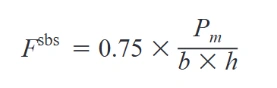
Short-Beam Strength—Calculate the short-beam strength using Eq 1 as follows:
where:
Fsbs = short-beam strength, MPa (psi);
P m = maximum load observed during the test, N (lbf);
b = measured specimen width, mm (in.), and
h = measured specimen thickness, mm (in.).
 Russian
  English
  Spanish