Uncovering the Core Stiffness Performance of Testing Machines (Part II)

Testing Machine Stiffness Measurement

Through the discussion in the previous article, we understood what testing machine stiffness is and why it matters, as well as the key components that influence stiffness.In this article, we will explore quantitative methods for measuring testing machine stiffness that can be used to evaluate whether a testing machine meets required standards.

In our previous article, we clarified **what testing machine stiffness is** and **why it matters**, as well as the key components that influence it. In this issue, we will explore with you whether there exist **quantitative methods for measuring testing machine stiffness** that can be used to evaluate whether a testing machine meets the required standards.

1.Existing Stiffness Measurement Methods for Testing Machines

Are there any measurement methods that can quantitatively evaluate testing machine stiffness? The answer is definitely yes. Several testing machine stiffness measurement methods are currently available on the market, but there are no unified and explicit regulations for their application in the industry.

Taking rock triaxial testing machines as an example, common stiffness measurement methods on the market include the theodolite measurement method, jack measurement method, oil valve control measurement method, piston stroke measurement method, etc. The principles and applicable scenarios of these methods are briefly introduced below.

(1)Theodolite Measurement Method

Method Principle

The autocolimator converts the tiny angular displacement of the measured object into the displacement of the image spot on the photodetector, from which the stiffness is then calculated.

Application Scenarios

The Theodolite Method is only used for the overall geometric stiffness measurement of ultra-large span, high-flexibility or specially configured frames. It is suitable for static or quasi-static loading (< 0.1 Hz) and is **not applicable** to small-size high-stiffness frames or high-frequency dynamic stiffness tests.

(2)Method Principle

The Jack Measurement Method is a static loading test method. By connecting a high-precision jack in series within the frame, and simultaneously measuring the displacement of the frame crossbeam (via extensometer/LVDT) and the output force of the jack, the frame compliance curve can be directly plotted. The machine deformation is then deducted from the total deformation of the specimen to obtain the true modulus of the material, from which the stiffness is calculated.

Application Scenarios

The Jack Measurement Method is mainly employed as an **in-situ loading benchmark**. It is applicable to the overall stiffness measurement of largetonnage (≥ 1 MN) testing machine systems, and is most reliable under static load, lowspeed, uniaxial compression or tension conditions. However, it is not suitable for highfrequency fatigue tests or highstiffness, smallstroke testing machines.

 Principle of the Method

By applying step or ramp pressure boosting through closed-loop oil valve control, signals from the load cell and the built-in displacement sensor of the actuator are acquired synchronously. The combined hydraulic-mechanical stiffness is derived using system identification algorithms. This method requires no additional sensors, but demands stable oil supply pressure, linear response of the servo valve, and that the specimen remains in the non-yielding state.

 Applicable Scenarios

The Oil Valve Control Measurement Method is suitable for the **online identification and compensation of overall machine stiffness** of electro-hydraulic servo testing machines under static or low-speed (<0.5 Hz) loading conditions. This method is not applicable to the calibration of high-stiffness, small-stroke or high-frequency dynamic stiffness.

(3)Piston Stroke Measurement Method

Principle of the Method

The Cylinder Piston Rod Displacement Measurement Method is an upgraded version of the Oil Valve Control Method. It is a stiffness testing technique that adopts a hydraulic cylinder as the loading element and takes the piston rod displacement as the deformation index.

This method calculates the equipment stiffness by using the displacement detected by the cylinder displacement sensor as the total deformation of the specimen and the loading frame. Its essence is to convert the force-displacement relationship into a hydraulic pressure-stroke relationship, and compute the structural stiffness by measuring the linear displacement of the piston rod.

Applicable Scenarios

The Piston Stroke Measurement Method is suitable for the **rapid online calibration of actuator-frame series stiffness** for electro-hydraulic servo or pneumatic testing machines under static and quasistatic loading conditions (≤ 1 Hz). It is not applicable to highstiffness, smallstroke systems, highfrequency dynamic tests, or microforce testing machines with significant oil film compression under high pressure.

Besides the limitations of applicable scenarios, these common methods also have drawbacks that affect the accuracy of measurement results:

 – The Theodolite Measurement Method requires a high-precision theodolite for testing; otherwise, the testing accuracy will be insufficient.

 – The Jack Measurement Method ignores factors such as loading alignment errors and manual operation errors, which lead to low testing accuracy.

 – The Oil Valve Control Measurement Method neglects the facts that hydraulic oil is compressible, the hydraulic circuit expands under pressure, and leakage increases with rising pressure. Moreover, manual valve control further results in inaccurate measurements.

 – The Piston Stroke Measurement Method overlooks that the cylinder displacement sensor only detects the **relative position** of the piston rod, which cannot accurately reflect the deformation of the machine frame. It also fails to consider the influence of the hydraulic oil column.

A testing machine is composed of multiple components. The measurement of its stiffness requires full consideration of comprehensive factors, including the complex structure, machining accuracy of each component, fasteners, and the reliability of clamping mechanisms. Therefore, mastering a relatively accurate method for testing machine stiffness measurement is critical to ensuring the testing accuracy of the machine.

2. FourPoint Direct Deformation Measurement Method

Based on years of experience in the R&D and manufacturing of testing machines, **Sinotest Equipment Co., Ltd.** has proposed the **Four-Point Direct Deformation Measurement Method**. This method is mainly applicable to the overall stiffness measurement of confining pressure triaxial testing machines and true triaxial testing machines. The basic principle of this method is: By directly measuring the deformation data of the frame when the rock triaxial testing machine applies the maximum load to the specimen, the actual stiffness value can be obtained by substituting the measured deformation data and force value into the formula. The Four-Point Direct Deformation Measurement Method generally involves the following steps to measure the stiffness of a triaxial testing machine:

(1)First, preheat the testing machine and the control & data acquisition system;

(2) After installing the metal specimen fixture, perform **3 cycles of full loading and unloading**;

(3) Prepare 4 dial gauges (or 4 deformation sensors) and select four test points in a **cross-shaped distribution** as shown in the figure below. The test points should be positioned as close to the loading center as possible.
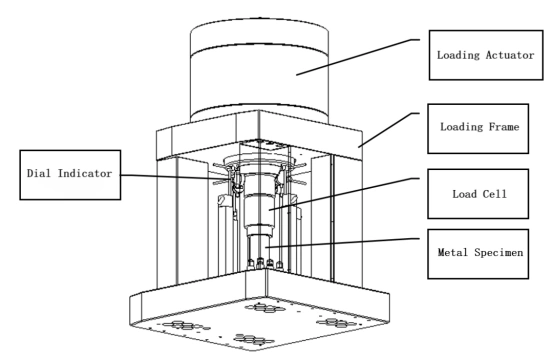
Schematic Diagram of Stiffness Measurement 

Figure 2: Schematic Diagram of Stiffness Measurement

(4) Measure the frame deformation with dial gauges under the maximum load condition. Repeat the measurement at each point at least 3 times and take the average value. (If simultaneous measurement at all 4 points is not possible, the measurement may be performed in 4 separate times, but a testing machine shall be tested at no fewer than 4 points in total.)

(5) Calculate the stiffness value using the stiffness calculation formula provided above. The acceptance criterion is that the stiffness value at each test point meets the specified stiffness requirements.

3. Test Status & Result Analysis

We conducted stiffness testing on three typical triaxial testing machines equipped with conventional frames from Sinotest, using the Four-Point Direct Deformation Measurement Method.Their technical parameters, testing procedures and measurement results are presented below, which verifies the feasibility of applying this method to actual production.

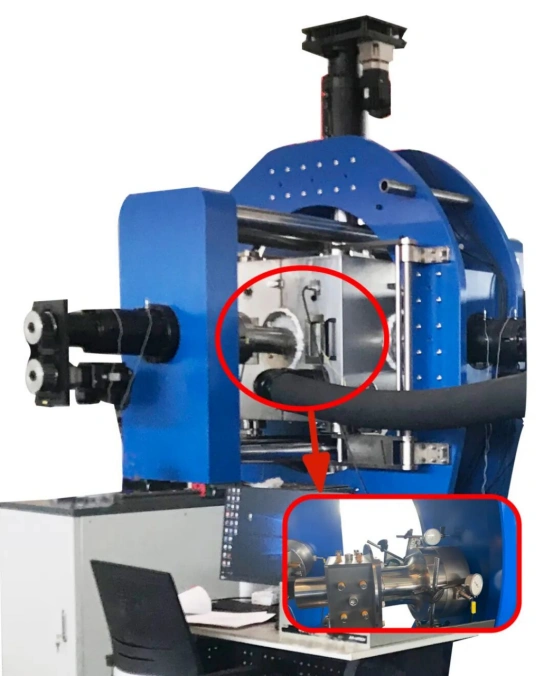
Rock True Triaxial Testing Machine

ZSZ-3000

Frame Type: Column-type Gantry Frame

Technical Specifications

Maximum Loading Capacity:Compression: 1000 kN (X/Y axes), 3000 kN (Z axis);

Force Measurement Accuracy: ≤ ±0.5% of indicated value;

Main Frame Stiffness: ≥ 10 GN/m.

Stiffness Test Procedure:
Rock True Triaxial Testing Machine

Stiffness Test Results:

X-axis stiffness: 25 GN/m

Y-axis stiffness: 25 GN/m

Z-axis stiffness: 14.28 GN/m

 Result Analysis: The stiffness of each axis exceeds 10 GN/m, which meets the technical specifications.


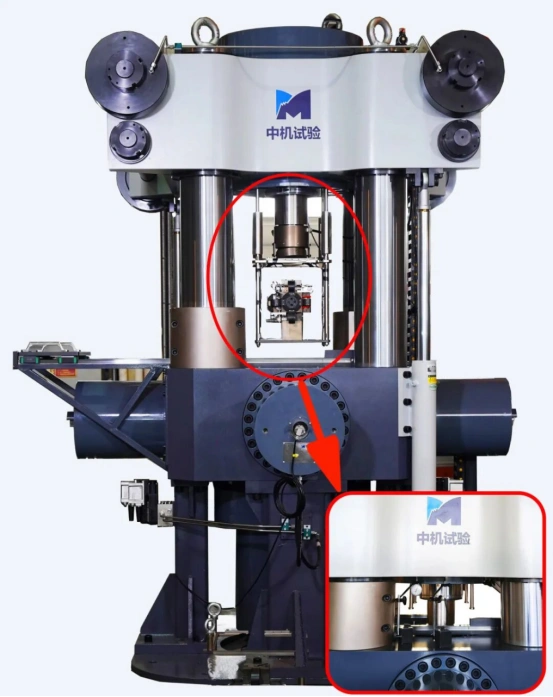
Asphalt Pavement Material True Triaxial Testing Machine

ZSZ-200

Frame Type:Four-column and assembled combined frame

Technical Specifications

Maximum Loading Capacity:Horizontal X/Y axes: ±100 kN;Vertical Z axis: ±200 kN;

Maximum Dynamic Frequency: 25 Hz;

Force Measurement Accuracy: ≤ ±0.5% of indicated value;

Main Frame Stiffness: ≥ 1 GN/m.

Stiffness Test Procedure

Asphalt Pavement Material True Triaxial Testing Machine

Stiffness Test Results X-axis stiffness: 1.1 GN/m

  • X-axis stiffness: 1.0 GN/m
  • Y-axis stiffness: 1.1 GN/m

 Result Analysis: The stiffness of each axis exceeds 1 GN/m, meeting the technical specification requirements.

Confining Pressure Triaxial Testing Machine

YSS-2000

Frame Type:Integrated Rectangular Frame

Technical Specifications:

Maximum Loading Capacity:Vertical Z-axis compression: 2000 kN

Confining Pressure: 100 MPa

Force Measurement Accuracy: ≤ ±0.5% of indicated value

Main Frame Stiffness: ≥ 10 GN/m

Stiffness Test Procedure:
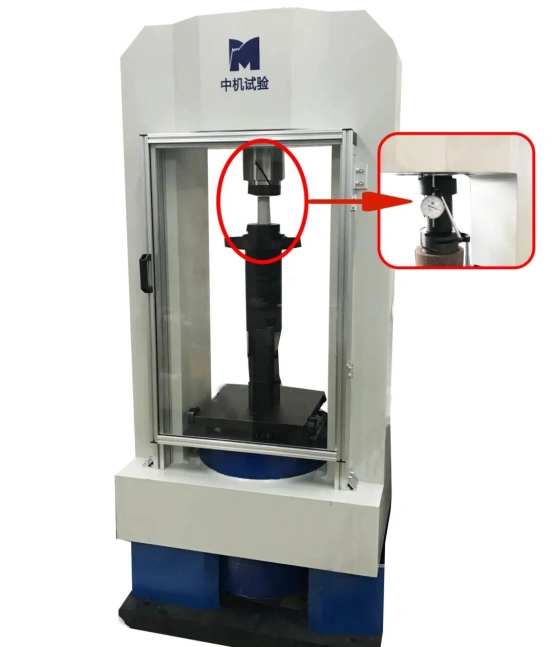
 Confining Pressure Triaxial Testing Machine

Stiffness Test Results Z-axis stiffness: 10.52 GN/m

Result Analysis: The stiffness of each axis exceeds 1 GN/m, meeting the technical specification requirements.

4.Discussion on Advantages and Disadvantages of the Four-Point Direct Deformation Measurement Method

The four-point direct deformation measurement method is innovatively based on the principle of the piston stroke measurement method. It utilizes the loading cylinder of the triaxial testing machine to achieve displacement control, and constructs a high-precision deformation measurement system by directly arranging four measuring points at key positions of the frame.

 The core advantage of this method lies in that four-point measurement can actively capture and offset the coupled deformation errors introduced by factors such as structural asymmetry, machining and assembly deviations, and internal force distribution within the system. In this way, the pure and true frame deformation can be extracted, ensuring the accuracy and reliability of the measured data. At present, this method has been verified by a large number of project tests at SINOTEST. It features simple operation, accurate inspection and low cost, and is suitable for factory stiffness inspection of triaxial testing machines.

 Like other stiffness testing methods for testing machines, the four-point direct deformation measurement method also has its limitations. For example, with the increasing structural complexity of test equipment, it is difficult to install deformation sensors at the loading center; instead, only four points close to the center can be selected. Therefore, the measured deformation approaches the maximum deformation, and the measured stiffness approaches the actual stiffness of the equipment. In addition, the measurement points and the included angles between them are manually selected and mapped, which may lead to inconsistencies in the measurement radius and other factors, resulting in a certain error between the measured stiffness and the actual stiffness. With the increasing number of market application cases, the four-point direct deformation measurement method will also be continuously iterated and optimized to achieve higher-precision stiffness measurement of rock triaxial testing machines.

5. Summary

It can be seen from the case of the rock triaxial testing machine that there are various methods for quantitatively measuring the stiffness of testing machines. However, few methods can fully consider comprehensive factors such as the complex structure and machining accuracy of each component, fasteners, and the reliability of clamping mechanisms to achieve high-precision measurement of testing machine stiffness.


Leave a Comment

Your email address will not be published. Required fields are marked *

en_USEnglish