
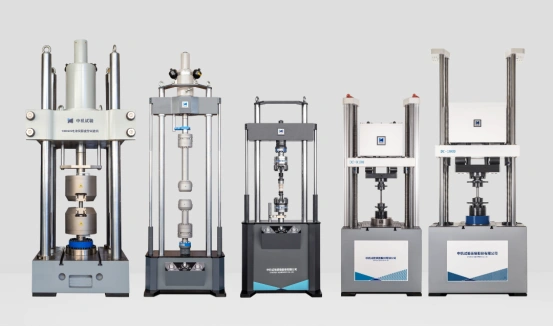
To understand what testing machine stiffness is, we must start with the concept of **stiffness** itself.
Stiffness generally refers to the ability of a material or structure to resist elastic deformation under an applied force, and it characterizes how easily a material or structure undergoes elastic deformation.
Extended from the definition of stiffness, **“testing machine stiffness ①”** refers to the overall deformation resisting capacity of the complete testing machine system (including the main frame, actuator, sensor, grip, etc.). It is usually defined as the ratio of the applied load to the deformation (or displacement) produced by the testing machine under that load.
It is important to distinguish the concept of **stiffness** from **strength**:
Strength refers to the ability of a member or component to resist failure (fracture) or excessive deformation under an external force.
In summary:**Stiffness** is a structure’s *ability to resist deformation*, while **strength** is its *ability to resist failure*.
【① GB/T 17200-2008 Technical Specifications for Tension, Compression and Bending Testing Machines for Rubber and Plastics (Constant Speed Drive), p.11】
The importance of testing machine stiffness lies in its direct impact on the accuracy of test results.
Put simply, stiffness describes how “rigid” a testing machine itself is when applying a load. As the testing machine exerts a load on a specimen, its own mechanical structure bears an equal reaction force.
The greater the stiffness of the testing machine, the smaller its own deformation under the same applied load; conversely, the lower the stiffness, the larger its own deformation.
The total displacement measured by the testing machine’s sensor is the sum of the specimen deformation and the deformation of the testing machine system.
If the stiffness of the testing machine fails to meet requirements, the machine will deform like a spring. The displacement caused by this deformation will be recorded by the sensor, seriously contaminating the raw data collected and resulting in a significant reduction in the measurement accuracy of the specimen’s true deformation.
In summary, testing machine stiffness is critically important in mechanical property tests of materials, including tension, compression, bending and fatigue tests.
We now take the **rock triaxial testing machine** as an example to explain the importance of testing machine stiffness.
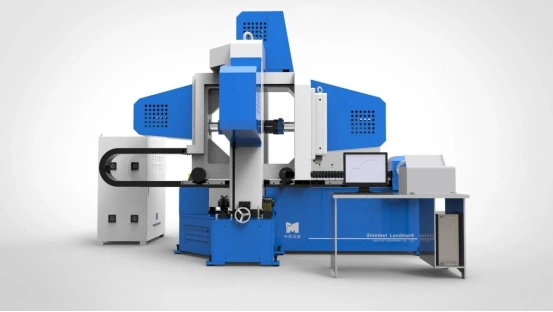
If the stiffness of a triaxial testing machine is lower than that of rock-like materials, the elastic potential energy stored in the machine during loading will be greater than that stored in the rock specimen.
When the load on the specimen reaches its limit, cracks will occur and its load-bearing capacity will drop sharply.
This triggers an immediate release of the large elastic potential energy stored in the testing machine, which applies an additional load far exceeding the ultimate strength to the specimen.
The specimen then fails abruptly, bringing the test to an early end and preventing the acquisition of the **post-peak curve** of the rock specimen’s stress-strain curve.
Therefore, the *Specification for True Triaxial Tests of Rock (T-CSRME 007-2021)* requires that the stiffness of the testing machine must be considerably greater than the maximum stiffness of the tested specimen, and shall not be less than 5 GN/m.
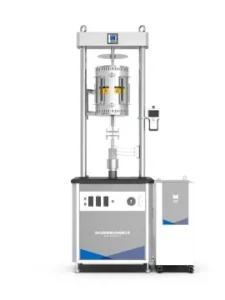
The stiffness of a testing machine is affected by the stiffness of its various components, including mechanical parts such as the loading frame, fastening bolts, loading actuator piston rod, loading rod, load cell, grip platen, as well as the hydraulic oil column. The stiffness of these components directly or indirectly affects the overall stiffness of the assembled testing machine.
Among all the components of the testing machine, the machine frame acts as the structural support for the entire system. Its role is equivalent to the beams and foundation of a building, as it directly withstands the reaction forces applied to the testing machine during operation. Therefore, the stiffness of the testing machine frame has the **greatest influence** on the overall stiffness of the machine.
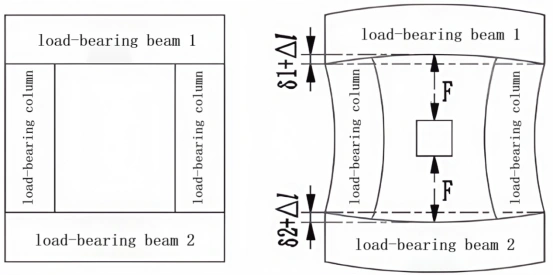
A testing machine frame can generally be considered as a closed frame composed of two symmetrically arranged load-bearing beams and load-bearing columns. Its state under loading is shown in the figure below: the left side is the state before loading, and the right side is the state after loading.
Frame stiffness is determined by the frame material and its overall structure. Therefore, in frame design, high-quality materials should be selected, appropriately sized components adopted, and a compact structure employed to meet the stiffness requirements of the frame.
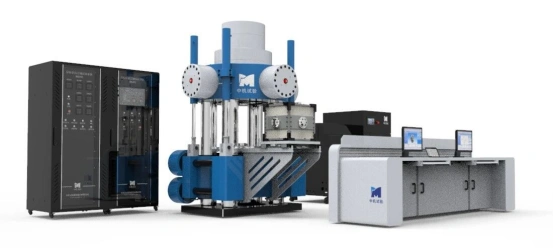
Taking the rock triaxial testing machines independently developed by SINOTEST as an example, different frames are matched according to the tested specimens and their test requirements.
For instance, triaxial testing machines used for testing soft rock, asphalt and other pavement materials generally adopt a **four-column frame**, ensuring an overall stiffness greater than 1 GN/m.
By contrast, triaxial testing machines for hard rock employ an **integrally closed cast (or forged) frame**, which guarantees the machine stiffness exceeds 10 GN/m and meets the requirements of relevant standards.
In addition to the frame stiffness, the stiffness and structure of components such as the actuator, load cell, loading rod and grip platen also affect the overall stiffness of the testing machine.
Overall, the stiffness of a testing machine depends not only on the structural dimensions of the machine itself, but is also influenced by the geometric dimensions and deformation characteristics of the specimen.Among all the components of the testing machine, frame stiffness has the **dominant effect** and directly determines the overall stiffness of the machine.
Therefore, compact, monolithic structures should be used as much as possible in the design of rigid testing machines.
It is also necessary to measure the actual stiffness of the testing machine after its assembly is completed.
Through the discussion in this issue, we have understood **what testing machine stiffness is** and **why it is important**, as well as the key components that determine testing machine stiffness and how they affect it. In the next issue of SINOTEST’s special column series, we will continue our focus on testing machine stiffness and explore with you whether it can be quantitatively measured to judge whether the testing machine meets the required standards.
We look forward to continuing our journey with you to explore the profound mysteries of testing machine technology.
 Russian
  English
  Spanish