
Industry Standard - Plastics - ASTM D412
The ASTM D412 standard defines procedures used to evaluate the tensile (tension) properties of vulcanized thermoset rubber and thermoplastic elastomers.
The methods appear as follows: Test Method A—Dumbbell and Straight Section Specimens; Test Method B-Cut Ring Specimens. (These two different methods do not produce identical results.)
The values stated in either SI or non-SI units shall be regarded separately as normative for this standard. The values in each system may not be exact equivalents; therefore each system must be used independently, without combining values.
Thermoset rubber is cured and set into a shape through heat application. Curing is an irreversible chemical reaction, which makes thermoset rubber products stronger and more durable. Products made of thermoset rubbers include tires, hockey pucks, circuit breakers, electrical housing, and motor components.
Thermoplastic elastomers (TPE) are polymers, polymer blends or compounds. They normally begin in pellet form, become liquid when heated, and can then be injected into a mold, for example. The thermoplastic takes shape as it cools and hardens. This process can be reversed by re-heating the material. TPE applications include drive belts, shock absorbers, breathing tubes, catheters, and shoe soles.
Приложения:
It claims specifications for the testing machine system, the test specimens (including shape and size), and for the test procedure and appropriate methods to be used. It helps determine various material characteristic values, which can then be used in the development of new products, in meeting product performance goals, or for research and quality control. The materials described in ASTM D412 can be used in a variety of industries, including construction, aerospace, medical engineering, e.g. in the testing of rubber products; the automotive industry; in the testing of dampers, seals, tires and much more.
Specimens
The most commonly used specimen is a C-shape dumbbell specimen (ASTM D412 Type C) with an overall length of 115 mm (4.5 inches), gauge length of 25 mm (1 inch), measurement width of 6 mm (0.25 inches) and thickness of 3 mm. Three measurements must be made of the thickness, whereby the median of the three measurements is used as the thickness in calculating the cross sectional area.
| Type | Note | l3 mm | l1 mm | b2 mm | b1 mm | h mm | L0 mm | Shape |
| A | Possible dimensions | ≥140 | 59±2 | 25±1 | 12+0.05 | 1.3~3.3 | 50±0.5 | Dumbbell specimen |
| B | Possible dimensions | ≥40 | 59±2 | 25±1 | 6+0.05 | 1.3~3.3 | 50±0.5 | Dumbbell specimen |
| C | Preferred specimen | ≥115 | 33 | 25±1 | 6+0.05 | 1.3~3.3 | 25±0.25 | Dumbbell specimen |
| D | Possible dimensions | ≥100 | 33±2 | 16±1 | 3+0.05 | 1.3~3.3 | 25±0.25 | Dumbbell specimen |
| E | Possible dimensions | ≥125 | 59±2 | 16±1 | 3+0.05 | 1.3~3.3 | 50±0.5 | Dumbbell specimen |
| F | Possible dimensions | ≥125 | 59±2 | 16±1 | 6+0.05 | 1.3~3.3 | 50±0.5 | Dumbbell specimen |
| 1 | Preferred dimensions | 17.9 | 15.9 | 1~3.3 | 50 | Ring specimen | ||
| 2 | Larger dimension | 35.8 | 31.8 | 1~3.3 | 100 | Ring specimen |
NOTE:
L0: Gauge length
L: Grip-to-grip separation
L1 Length of the narrow parallel section/inner diameter
L2: Distance between the wide parallel sections
L3:Total length / outer diameter
b2:Specimen width in shoulder area
b1:Specimen width in gauge length area
H:Specimen thickness
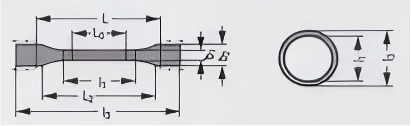
Characteristic values
Tensile stress: stress applied to stretch a specimen
Tensile stress at a given elongation: stress required to stretch the uniform cross section of a test specimen to a given elongation
Tensile strength: maximum tensile stress applied while stretching a specimen to the point of rupture
Yield point: the point in the stress-strain curve, short of ultimate failure, where the rate of stress with respect to strain goes through a zero value and may become negative
Ultimate elongation: the elongation at the time of rupture
Tensile set: extension remaining after a specimen has been stretched then allowed to retract in a specified manner, expressed as a percentage of the original length