
What is Tensile Testing (ISO 6892-1)?
Tensile testing is the fundamental mechanical property test that measures the behavior of metallic materials under uniaxial tensile load at ambient temperature (typically 10°C to 35°C). It determines how a material stretches and eventually breaks when pulled. This standard provides the unified method for determining key properties such as yield strength, tensile strength, elongation, and reduction of area. Unlike creep testing which focuses on time-dependent deformation under constant load at high temperatures, ISO 6892-1 focuses on the immediate response to increasing load at room temperature, serving as the primary quality control and design basis for structural metals.
What is a typical Stress-Strain Curve?
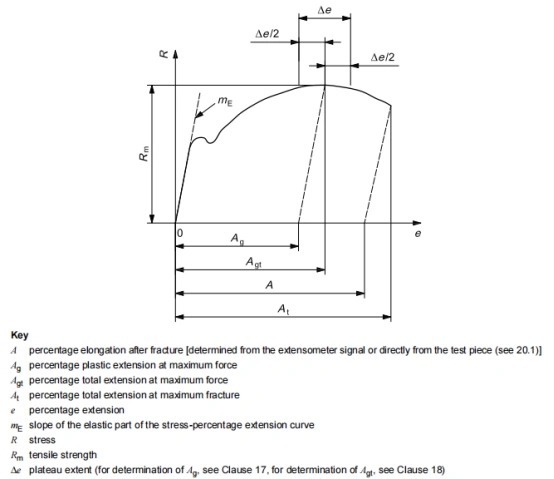
A typical stress-strain curve obtained from ISO 6892-1 can be divided into distinct regions:
① Elastic Region: The initial linear portion where deformation is reversible. The slope represents Young’s Modulus (E).
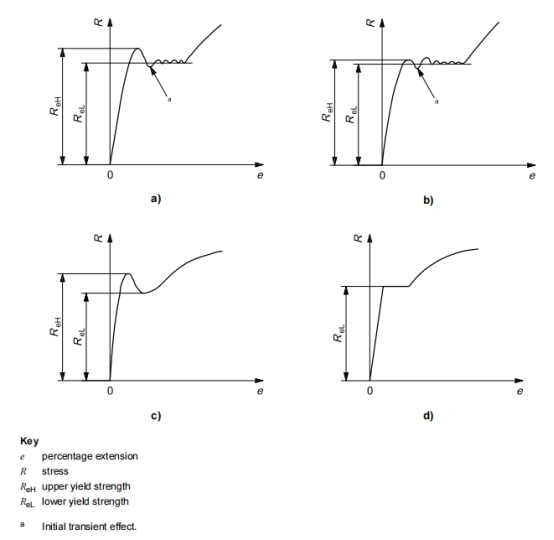
② Yield Point: The transition from elastic to plastic deformation. For materials with a distinct yield point, this is marked by upper yield strength (ReH) and lower yield strength (ReL). For continuous yielding materials, it is defined by the proof strength (Rp0.2), the stress at 0.2% permanent strain.
③ Strain Hardening: After yielding, the material strengthens as it deforms, requiring increased stress to continue stretching.
④ Ultimate Tensile Strength (Rm): The maximum stress the material can withstand. Beyond this point, necking (localized reduction in cross-section) begins.
⑤ Fracture: The point where the specimen breaks. The total elongation (A) and reduction of area (Z) are measured here to characterize ductility.
Discovery and Evolution of Tensile Testing
The concept of testing material strength dates back to Leonardo da Vinci’s experiments with wires, but standardized tensile testing emerged during the Industrial Revolution to ensure the safety of bridges, railways, and boilers. In the 20th century, as metallurgy advanced, the need for precise definitions of “yield” and “ductility” became critical. ISO 6892-1 was developed to harmonize various national standards (like ASTM E8 in the US or EN 10002-1 in Europe) into a single global reference. The 2009 revision introduced significant changes, particularly in the definition of strain rates and the distinction between method A (strain rate control) and method B (stress rate control), ensuring more consistent results across different testing machines globally.
Key Parameters Defined by ISO 6892-1:2009
The standard defines specific indices for material performance:
Yield Strength (Re or Rp): The stress limit for elastic design. Exceeding this causes permanent deformation.
Tensile Strength (Rm): The maximum load-bearing capacity, crucial for safety factors against catastrophic failure.
Elongation (A): The percentage increase in gauge length after fracture, indicating formability and toughness.
Reduction of Area (Z): The percentage decrease in cross-sectional area at the fracture point, a measure of true ductility.
There are many factors that affect the results, among which the most important are extensometer accuracy, alignment of the testing machine, specimen geometry, and control of the strain rate.
ISO 6892-1:2009 Metallic materials — Tensile testing — Part 1: Method of test at ambient temperature
This standard covers the determination of tensile properties of metallic materials at ambient temperature. It specifies the requirements for testing machines, force measurement systems, extensometers, and test pieces. It defines two methods for controlling the testing rate:
Method A: Strain rate control based on extensometer feedback (preferred for accurate yield determination).
Method B: Stress rate control or crosshead displacement control (traditional method, allowed within specific limits).
The key contents covered by the standard include:
Sample specifications and preparation requirements (machined vs. full-section specimens).
Testing machine verification and alignment protocols.
Extensometer classification and calibration (Class 0.5, Class 1, etc.).
Precise definitions of strain rates for elastic and plastic regions.
Principles of Data Collection and Curve Drawing.
Calculation methods for yield strength, tensile strength, and ductility parameters.
Rules for rounding and reporting test results.
Referenced ISO Standards
ISO 7500-1: Calibration and verification of static uniaxial testing machines.
ISO 9513: Verification of force-measuring systems.
ISO 10002-2 (Withdrawn/Superseded): Previously related to extensometers, now integrated into ISO 6892-1 requirements.
ISO 377: Preparation of test pieces for mechanical testing.
ISO 6892-2: Tensile testing at elevated temperatures.
ISO 25178: Surface texture (relevant for specimen finish).
Related standards for metal mechanical tests
ASTM E8/E8M: Standard Test Methods for Tension Testing of Metallic Materials (US equivalent).
EN 10002-1: (Superseded by EN ISO 6892-1) Tensile testing of metallic materials.
ISO 12135: Unified method of test for the determination of quasistatic fracture toughness.
ISO 15630-1: Steel for the reinforcement and prestressing of concrete — Test methods (references ISO 6892-1 for tensile properties).
ASTM E647: Standard Test Method for Measurement of Fatigue Crack Growth Rates.
ASTM E606: Standard Practice for Strain-Controlled Fatigue Testing.
ISO 12106: Fatigue testing — Axial-strain-controlled method.
ASTM E139: Standard Test Methods for Conducting Creep, Creep-Rupture, and Stress-Rupture Tests (High temperature counterpart).
ISO 204: Metallic materials – Uniaxial creep testing in tension.
Environment:
Testing is conducted at ambient temperature, defined as 10°C to 35°C. For critical testing, a tighter control of 23°C ± 5°C is often recommended. Humidity is generally not controlled unless specified for specific corrosion-sensitive materials.
Test Procedure:
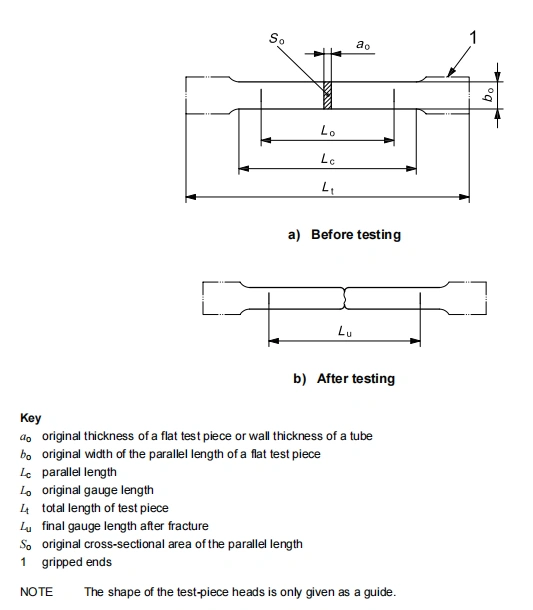
- Sample Preparation: Prepare standard size specimens (proportional gauge length: L0 = k *sqrt{S0} (usually k=5.65 )according to ISO 6892-1 and ISO 377. Ensure surfaces are free of scratches and machining marks that could act as stress concentrators.
- Dimensional Measurement: Measure the original cross-sectional dimensions (S0) with high precision (micrometers) to calculate stress.
- Equipment Verification: Use a calibrated universal testing machine (UTM) verified per ISO 7500-1 (Class 1 or better) and an extensometer verified per ISO 6892-1 requirements (Class 1 or 0.5).
- Mounting: Align the specimen carefully to avoid bending stresses. Attach the extensometer to the gauge length.
- Loading (Method A Recommended): Elastic Phase: Apply load at a controlled stress rate or strain rate up to the expected yield region. Plastic Phase: Switch to a constant strain rate (typically 0.00025/s to 0.0025/s depending on the material specification) through yielding and up to fracture.
- Data Collection: Real-time collection of Force vs. Extension data. The system automatically calculates Stress vs. Strain.
- Post-Test Measurement: Fit the broken pieces together to measure the final gauge length (Lu) for elongation and measure the minimum diameter at the neck for reduction of area.
- Curve Analysis: Determine ReH, ReL, Rp0.2, Rm , A , and Z from the curve.
- Report Preparation: Provide a detailed testing report including material ID, specimen dimensions, test method (A or B), strain rates used, and all calculated mechanical properties.