
Industry Standard – Plastics – ASTM D638

Industry Standard - Plastics - ASTM D638

It mainly describes the test method for determination of the tensile properties of reinforced and unreinforced plastics. It helps determine essential mechanical properties, including tensile stress, strain, tensile modulus, tensile strength, tensile strength at yield and tensile strength at break. This test method can be used for testing materials of any thickness up to 14mm (0.55 in.). However, for testing specimens in the form of thin sheeting, including film less than 1.0mm (0.04 in.) in thickness, Test Methods D 882 is the preferred test method. Materials with a thickness greater than 14 mm (0.55 in.) must be reduced by machining. This test method includes the option of determining Poisson’s ratio at room temperature.

Characteristic values

Typical characteristic values are as below, which describe the essential mechanical properties of a molding compound or a specimen machined from a defined area of a component.

Tensile stress: force related to the initial cross section of the specimen;

Strain: change in gauge length with reference to the initial gauge-length;

Tensile modulus: gradient of the curve in the stress-strain diagram;

Yield point: stress and strain at the curve plot point at which the gradient is zero;

Point of break: stress and strain at the moment of specimen break;

Poisson’s ratio: negative ratio of transverse strain to axial strain.

Test specimen

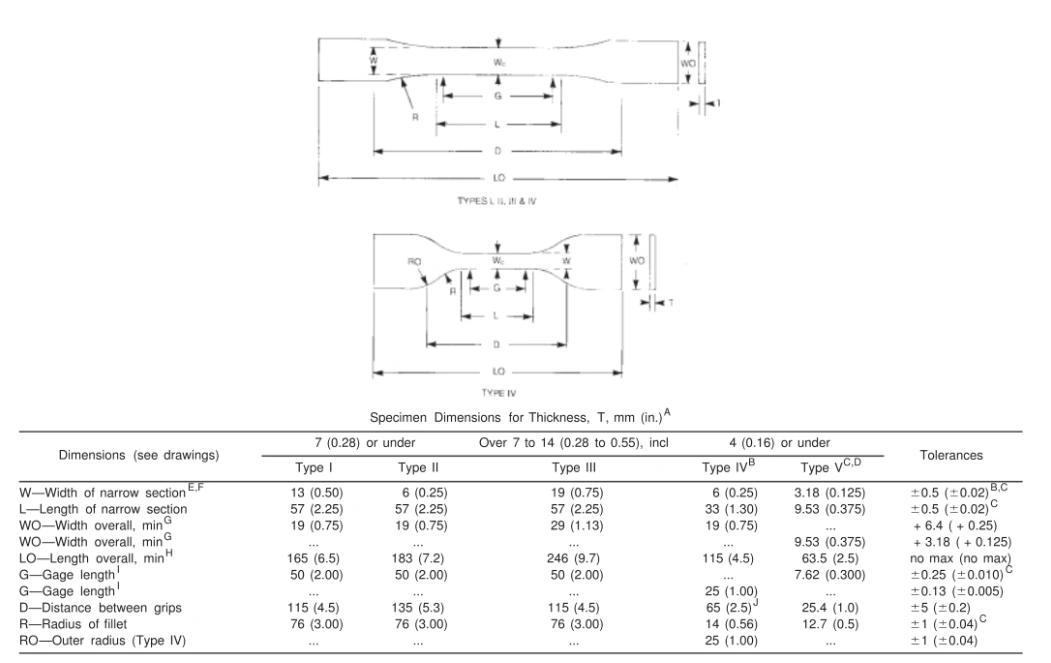
ASTM D638 Type I: The preferred test specimen is the dumbbell Type I, which with a thickness of 3.2mm (1/8 inch) and a gauge length of 50mm (2 inches) is still relatively similar to common component material thicknesses and at the same time allows for a good level of strain measurement accuracy.

ASTM D638 Type II: Provided that by using the test specimen Type I a fracture cannot be produced in the narrow parallel part of the specimen, ASTM D638 recommends the use of a test specimen Type II, in which the width of the narrow parallel section is significantly reduced.

ASTM D638 Type III: If specimens with material thicknesses of more than 7 mm can be obtained through mechanical processing, then specimen Type III is used. Here, the width of the narrow parallel section, as well as the shoulder width and the overall length are increased so that the specimen thickness remains less than the width. For sheet thickness of more than 14 mm, the thickness is adjusted through mechanical processing.

ASTM D638 Type IV: The test specimen Type IV is ideal for testing of very soft polymers (e.g., rubber) and is used when comparing soft and more stiff polymers.

ASTM D638 Type V: If only a small amount of material is available, or if machining the specimen from a component does not allow for a larger specimen, then a Type V specimen is used, which is reduced in every dimension relative to Type I.http://www.camcjsw-testmachines.com/wp-content/uploads/2026/03/ASTM-D638-1.webp
Оставьте комментарий

Ваш адрес email не будет опубликован. Обязательные поля помечены *

ru_RURussian