
ASTM D1621 Compression test on rigid cellular plastic (according to ISO 844)
Compressive properties include the Compressive Strength, Max. Compressive Deformation, and the Compression Modulus, which describes the Short-term Deformation under load. The testing standards differ in the dimensions of the specimen and in the test execution.
ISO 844 and EN 826 describes that the movement of the compression platen is typically measured by the cross-head travel of the testing machine with a defined minimum accuracy, ASTM D1621 describes another method that compensates for the self-deformation of the testing machine. All these standards permit direct displacement measurement of the compression platen.
Relative terms and definition
Nominal Relative Deformation:
εc, ratio of the reduction (in relation to its initial value)in thickness of the test specimen;
Relative Deformation:
ε, ratio of the reduction (in relation to its initial value) of extensometer gauge length;
Compressive Strength:
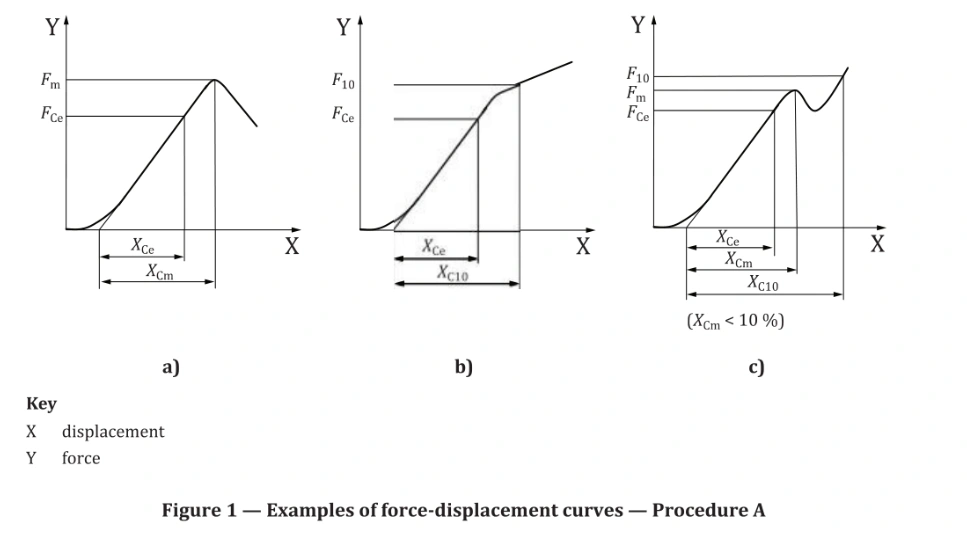
σm, max. compressive force Fm divided by the initial cross-sectional area A0 of the test specimen when the relative deformation ε and the nominal relative deformation εc respectively is <10%;
Compressive Stress at 10% Nominal Relative Deformation:
σc10 , ratio of the compressive force F10 at 10% nominal relative deformation εc10 to the initial cross-sectional area of the test specimen;
Nominal Compressive Modulus of Elasticity:
Ec , difference in compressive stress divided by the difference in corresponding nominal relative deformation below the proportional limit, i.e.when the relation is linear;
Compressive modulus of Elasticity:
E, difference in compressive stress divided by the corresponding difference in relative deformation below the proportional limit, i.e. when the relation is linear;
Conventional proportional limit:
Xe, upper limit of the linear part of the Force-Deformation curve.
Test Methods
Procedure A
The compression-testing machine shall be fitted with a system allowing continuous measurement of the displacement x of the movable plate with an accuracy of ±5% or ±0.1mm if this latter value is a more accurate measurement.
Procedure B
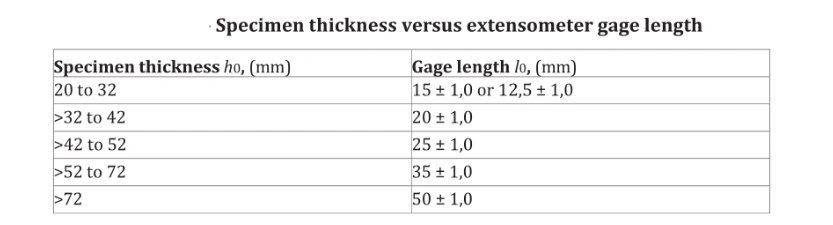
The compression-testing machine shall be equipped with an extensometer which directly measures the specimen deformation. If used, however, the extensometer shall comply with class 1 of IS0 9513. The extensometer gauge length as a function of specimen thickness is shown in Table-1.
Specimen
Force-Deformation curve
Procedure A
Procedure B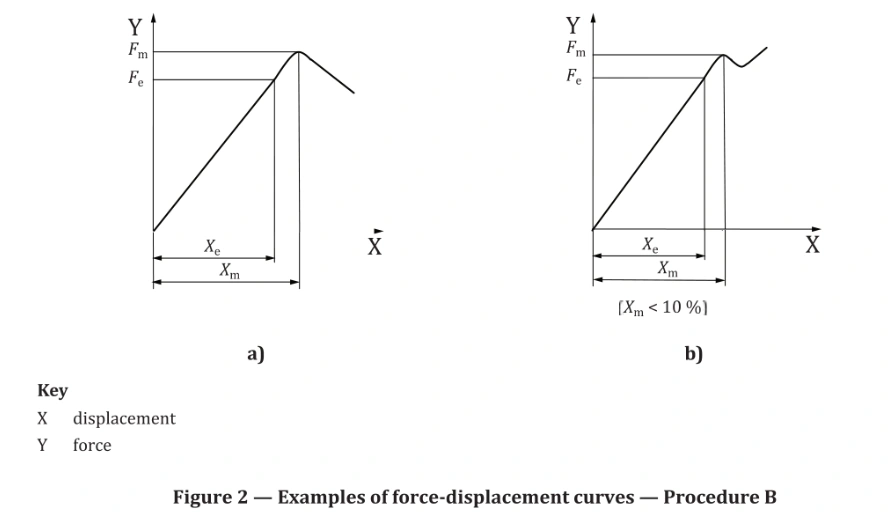
 Russian
  English
  Spanish