
What is Creep Test?
Creep test is a material mechanical property test that measures the slow plastic deformation phenomenon of metal materials under long-term constant temperature and constant stress. The higher the temperature or stress, the more significant the creep phenomenon. Creep can occur under a single stress (tension, compression, or torsion) or under composite stress. The usual creep test is conducted under uniaxial tensile conditions. In terms of stress rupture test, a differentiation is made between short term tests up to approximately 10,000 hours and long term tests starting at approximately 10,000 hours.
How does the environment affect behavior?
For plastic components with constant loads, the material will fail over a long period of time. Creep continues until a point, at which the material experiences catastrophic failure due to creep fracture. Similarly, due to the viscoelastic behavior of plastics, the creep rate depends on temperature, stress level, and chemical environment. Environmental stress cracking (ESC)- chemical environments – can have a dramatic impact on the long-term behavior of materials, leading to premature failure of components at levels far below expected stress.
Analysis of Standard
Temperature control accuracy ±3℃ ±2℃ (stricter)
Key technical points
The standard defines the calculation formula for the tensile creep modulus (Et): Et = σ/εt = (F·L0)/(A·ΔLt), where the initial stress σ needs to be kept constant (fluctuation ≤ ± 1%). Special attention should be paid during testing:
1.The sample should be pre treated under ISO 291 standard environment for at least 90 minutes (moisture balance);
2.Suggest using a loading rate of 1-5 seconds to avoid impact effects;
3.Recommended recording time point: Index interval from 1 minute to 1000 hours;
Mechanism of Physical Aging Effects
Appendix A elaborates on the significant impact of polymer physical aging on creep behavior: when the material is rapidly cooled from high temperature (such as near Tg) to the test temperature, the molecular structure gradually rearranges over time, resulting in:
1.The longer the aging time te, the more the creep curve shifts towards a longer time direction
Age status reset phenomenon may occur during temperature rise testing;
2.The alpha relaxation process of amorphous phase in semi crystalline polymers is also affected;
Engineering application suggestions
For data collection under design purposes, it is recommended to:
1.The stress range should cover at least 3 gradients, and it is recommended to have a yield strength of 50% -90%;
2.Time range: Short term (1h)+Medium term (100h)+Long term (1000h+);
3.Environmental control requires monitoring of RH changes in humidity sensitive materials (such as nylon);
Typical data presentation methods should include: isothermal stress-strain curves (ISO 11403-1) and three-dimensional creep surface plots.
Relevant standards for creep tests on plastics
ISO 899-1 Determination of creep behavior – Part 1: Tensile creep
ISO 899-2 Determination of creep behavior – Part 2: Flexural creep by three-point loading
ASTM D2990 Standard Test Methods for Tensile, Compressive and Flexural Creep and Creep-Rupture of Plastics
ISO 16770 Plastics–Determination of environmental stress cracking (ESC) of polyethylene – Full-notch creep test (FNCT)
ISO 3384-1 Rubber, vulcanized or thermoplastic–Determination of stress relaxation in compression
ASTM D1780 Standard Practice for Conducting Creep Tests of Metal-to-Metal Adhesives
ASTM D2294 Standard Test Method for Creep Properties of Adhesives in Shear by Tension Loading (Metal-to-Metal)
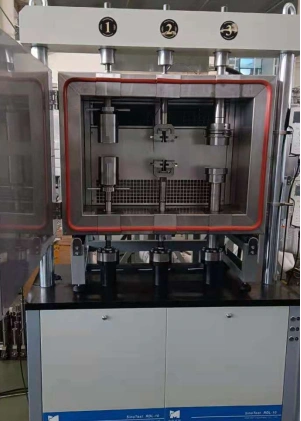
Multi-station plastic creep testing machine(3-6 station)
 English
  Spanish
  Russian