
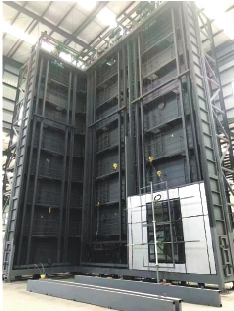
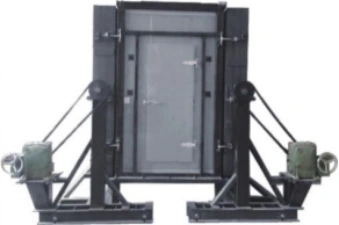
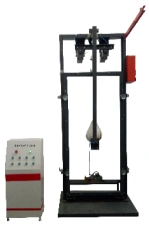
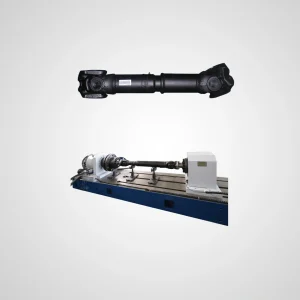
This series of machines can perform torsional fatigue tests on various shaft and rod components, such as torsional stiffness and strength tests, suitable for automotive transmission shafts, constant velocity universal joints, ball cages, half shafts, drive axle shells, etc.
Standard:
QC/T649 Automotive Steering Transmission Shaft Assembly Performance Requirements and Test Methods
QC/T29082 Technical Conditions and Bench Test Methods for Automobile Transmission Shaft Assembly
Torque range: 500~40000 N·m
Force measurement accuracy: Class 0.5~1
Load waveform: sine wave, square wave, etc.
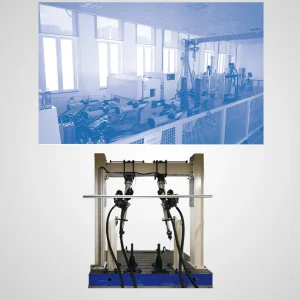
The automobile stabilizer fatigue testing bench is used to test the fatigue life of the automobile stabilizer. It applies electro-hydraulic servo technology, uses a hydraulic system for loading, and has a dedicated servo controller to output instructions to the linear servo actuator to test the loading of the stabilizer.
This test rig can perform fatigue, stiffness, and strength tests on the stabilizer bar. When equipped with an environmental chamber, tests can be conducted in high and low temperature environments, as well as muddy water environments. The control system can also perform spectrum iteration for comprehensive performance testing
Standard:
JASO C617 Automotive Parts Stabilizer Bar
Single actuator test force: 25kN~100kN
Force measurement accuracy: Class 0.5~1
Load waveform: sine wave, square wave, path spectrum, etc
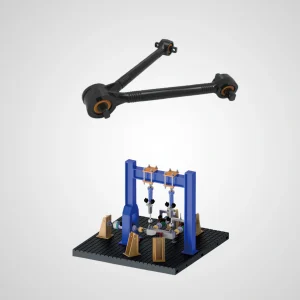
The Thrust rod fatigue loading test rig applies electro-hydraulic servo technology and uses a hydraulic system for loading. A dedicated servo controller can output commands to test the linear servo actuator. It is also possible to test the straight push rod, diagonal push rod, and Vshaped push rod by equipping them with different fixtures. Axial, radial, torsional, yaw, and coupled fatigue tests can also be conducted on the V-shaped push rod according to requirements.
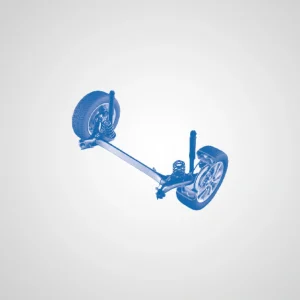
The Rear axle torsion beam test rig is used to test the rear axle torsion beam, shock absorber, and suspension spring assembly. Applying electro-hydraulic servo technology, hydraulic system loading is adopted, and a dedicated servo controller is used to output instructions to the linear servo actuator for experimentation.
This bench can be used for: parallel wheel jump force endurance test, lateral fatigue endurance test, 180 ° reverse displacement torsional fatigue test of left and right wheel cores, forward and backward braking fatigue endurance test, single side longitudinal force loading endurance test of wheel cores, single side vertical force fatigue test, static strength test, torsional stiffness test, etc.
Testing force: 25kN;
Force measurement accuracy: Class 0.5~1
Loading waveform: Sine wave, square wave, road spectrum, etc
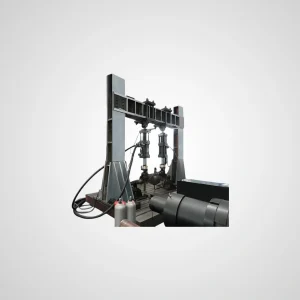
The Axle test rig can be equipped with 2 to 6 actuators to simulate the vertical, lateral, and longitudinal loads of the axle. The main components include: actuators, loading frames, work platforms, hydraulic systems, control systems, etc. The test rig is hydraulic loaded and suitable for fatigue performance testing of vehicle axles.
Standard: QC/T533 Commercial Vehicle Drive Axle Assembly
Test force: 200kN~1000kN;
Force testing accuracy: Class 0.5~1
Load waveform: sine wave, square wave, path spectrum, etc.
The Front subframe and loading arm test rig applies electro-hydraulic servo technology, uses a hydraulic system for loading, and conducts experiments by outputting instructions to the linear servo actuator through a dedicated servo controller.
This test rig can perform durability tests on the subframe and loading arm, driving impact tests, fatigue tests with lateral force in the same direction, static strength tests at the installation point, stiffness tests, X/Y impact tests on the swing arm, and static strength tests on the loading arm.
Testing force: 25kN~500kN
Force measurement accuracy: Class 0.5~1
Loading waveform: sine wave, square wave, path spetrum, etc.
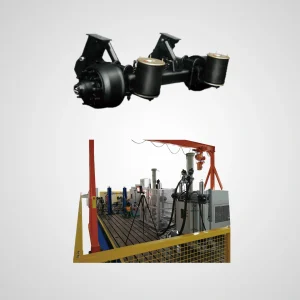
The suspension spring fatigue test rig uses a hydraulic system to load and conducts experiments on the output commands of linear servo actuators through a dedicated servo controller. It can be used to test the fatigue life and stiffness of suspension springs. When equipped with an environmental chamber, experiments can be conducted in high and low temperature environments.
Air suspension axle joint test: Adopting a multi-channel configuration to achieve maximum restoration of installation conditions, multiple loading channels can be configured, and multiple testing methods are applicable. Strong load-bearing capacity, high accuracy, with functions such as phase coordination and amplitude coordination.
For example, it can be equipped with four channels (2 vertical, 1 horizontal, and 1 longitudinal). The vertical channel is used to simulate the wheel load state, and the lateral and longitudinal channels are used to simulate the vehicle’s bearing of lateral and longitudinal loads.
Test force: 10kN~100kN;
Force measurement accuracy: Class 0.5~1
Load waveform: sine wave, square wave, path spectrum, etc.
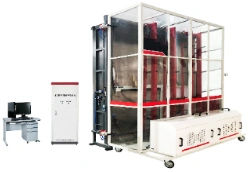
Purpose: Tests the three primary physical properties of building doors and windows: Air Permeability, Water Tightness, and Wind Load Resistance.
Applicable Standards: GB/T 7106
Model | MWS-2121A | MWS-2424A | MWS-3030A |
Wind Pressure Measurement Range | -200 Pa ~ +200 Pa | ||
Displacement Measurement Range | 0 ~ 60 mm | 0 ~ 80 mm | |
Pressure Transmitter Accuracy | Class 0.5 | ||
Displacement Gauge Accuracy | Class 0.2 | ||
Air Flow Measurement Range | 0.1 – 590 m³/h | ||
Water Flow Range | 0.35 – 45 L/min | ||
Specimen Size (mm) | 600×600 ~ 2100×2100 | 600×600 ~ 2400×2400 | 600×600 ~ 3000×3000 |
Control Cabinet Dimensions (mm) | 730 × 600 × 1760 (L×W×H) | ||
Equipment Footprint (mm) | 2960 × 5000 × 2900 (L×W×H) | 3260 × 5000 × 3350 (L×W×H) | 3860 × 5000 × 3950 (L×W×H) |
Power Supply | AC 380V, 14 kW | AC 380V, 21 kW | |
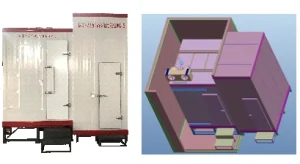
Purpose: Determines the Thermal Transmittance (U-value) and Condensation Resistance Factor of external doors and windows.
Applicable Standards: GB/T 8484
Key Specifications:
Model | MC-BW1821 | MC-BW1824 | MC-BW2121 | MC-BW2424 |
Maximum Specimen Size (mm) | 1800 × 2100 | 1800 × 2400 | 2100 × 2100 | 2400 × 2400 |
Chamber Dimensions (mm) | 3920 × 3610 × 4200 | 3920 × 3610 × 4500 | 3920 × 4000 × 4200 | 3920 × 4210 × 4500 |
Environmental Space Dimensions (mm) | 4600 × 4400 × 4300 | 4600 × 4400 × 4600 | 4600 × 4700 × 4300 | 4600 × 5000 × 4600 |
Temperature Measurement Accuracy | 0.2°C | |||
Temperature Control Accuracy | 0.1°C | |||
Heating Power Accuracy | Class 0.2 | |||
Heating Power Range | 10 ~ 900 W | |||
Test Method | Fully Automatic Microcomputer Control | |||
Power Supply | 380V, 8 kW | |||
Weight | 1450 kg | 1500 kg | 1600 kg | |
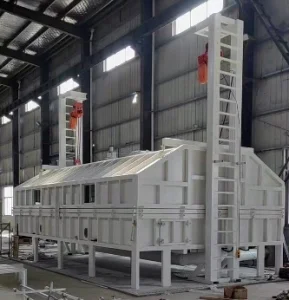
Purpose: Performs static and dynamic wind uplift resistance tests for metal roofing systems and evaluates their physical performance.
Applicable Standards: GB/T 31543, JGJ 255, FM 4471, ANSI FM 4474, ETAG 006, etc.
Key Specifications:
Pressure Control: Range: -10,000 Pa to +10,000 Pa; Accuracy: ±0.5%.
Flow Measurement:
Air Flow: 0 – 360 m³/h (±2.5%).
Water Flow: 0 – 6500 L/h (±2.5%).
Displacement Measurement: Range: 0 – 80 mm; Accuracy: Class 0.1.
Cyclic Testing: Programmable number of cycles with 100% control accuracy.
Max. Specimen Size: 7300 mm × 3700 mm.
Power Requirements: AC 380V, 65 kW.
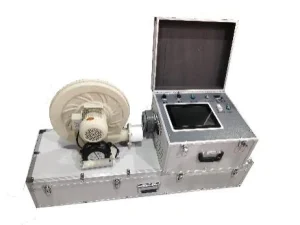
Purpose: Field testing of air permeability for installed building doors and windows.
Applicable Standards: JG/T 211, JGJ 132
Key Specifications:
Pressure Range: -200 Pa to +200 Pa (±0.5%).
Air Flow Range: 0.2 – 326 m³/h (±1.5%).
Test Range (Specimen): Height & Width ≤ 1800 mm.
Power Supply: AC 220V, 500W.
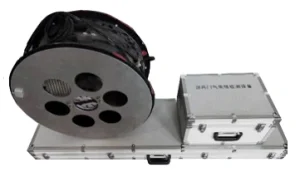
Purpose: Measures the overall air tightness of buildings (envelopes) and local air leakage using the fan pressurization method.
Applicable Standards: GB/T 34010
Key Specifications:
Indoor-Outdoor Pressure Differential: ±50 Pa.
Max. Air Flow Rate: 7500 m³/h (±5%).
Adjustable Frame: Width: 610 – 1010 mm; Height: 1325 – 2450 mm.
Power Supply: AC 220V, 50Hz, 750W.
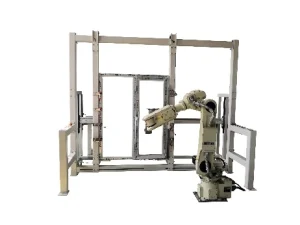
Purpose: Automated life-cycle testing for various door/window hardware. Can be extended to test doors for security, vehicles (high-speed rail, cars), etc.
Key Specifications:
Configuration: Floor-mounted industrial robot.
Payload Capacity: 20 kg.
Repeatability: ±0.06 mm.
Grippers: Features wear-resistant, four-wheel flexible grippers for different opening types (side-hung, sliding). Optional force sensors and specialized fixtures available.
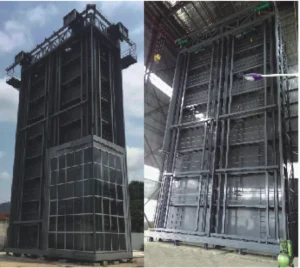
Purpose: Comprehensive performance testing for curtain walls, including air tightness, water tightness, wind load resistance, and inter-story deformation performance.
Applicable Standards: GB/T 15227, GB/T 21086, GB/T 18250, JGJ 102, 133, ASTM E283/E330/E331, AAMA 501.1/501.4, etc.
Key Specifications (Models: JSW-K40-60, JSW-K60-90, JSW-K100-160):
Model | JSW-K40-60 | JSW-K60-90 | JSW-K100-160 |
Wind Pressure Test Range | -8000 Pa ~ +8000 Pa | -10000 Pa ~ +10000 Pa | -10000 Pa ~ +10000 Pa |
Air Flow Test Range | 0 – 360 m³/h | 0 – 1500 m³/h | 0 – 3600 m³/h |
Water Flow Test Range | 4 L/(min·m) |
|
|
Displacement Test Range | 0 ~ 50 mm / 0 ~ 100 mm | 0 ~ 50 mm / 0 ~ 160 mm | 0 ~ 50 mm / 0 ~ 160 mm |
Equipment Power | 50 kW | 70 kW | 120 kW |
Plenum Chamber Dimensions | (Max. Specimen Width + 2200 mm) × 4500 mm × (Max. Specimen Height + 2500 mm) | Customizable based on order specifications |
|
Power Supply | Three-phase, five-wire system, AC 380V, 50 Hz |
|
|
Weight | 15 tons | 25 tons |
|
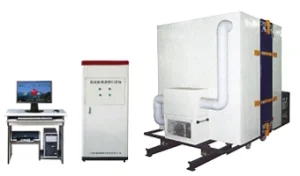
Purpose: Measures the thermal transmittance (U-value/k-value) of building walls and composite panel materials using the Guarded Hot Box method.
Applicable Standards: GB/T 13475
Key Specifications (Models: CD-WTF1515, 1212, 1010):
Model | CD-WTF1515 | CD-WTF1212 | CD-WTF1010 |
Metering Box Temperature Control Range | 10~50°C | ||
Cold Box Temperature Control Range | -10~-21°C | ||
Guard Box Temperature Control Range | 10~50°C | ||
Metering Box Power Measurement & Control Range | 10~400W | ||
Specimen External Dimensions (mm) | 1750 × (≤500) × 1750 | 1450 × (≤400) × 1450 | 1270 × (≤330) × 1270 |
Equipment External Dimensions (mm) | 2965 × 2385 × 2428 | 2965 × 2080 × 2128 | 2270 × 1570 × 1802 |
Metering Unit Dimensions (mm) | 1500 × 1500 | 1200 × 1200 | 1000 × 1000 |
Maximum Specimen Thickness (mm) | ≤500 | ≤400 | ≤330 |
Power Supply | AC 380V, Power: 7 kW | AC 380V, Power: 6 kW | AC 380V, Power: 6 kW |
Required Floor Area (mm) | 3960 × 6000 × 2628 | 3960 × 5400 × 2428 | 3270 × 4350 × 2280 |
Weight | 560 kg | 480 kg | 320 kg |
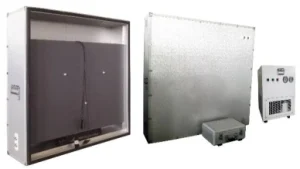
Purpose: In-situ or laboratory measurement of heat transfer coefficient (U-value), temperature, and heat flux for building envelopes.
Applicable Standards: JGJ/T 132, JGJ/T 357, GB/T 23483
Key Specifications
Model | CD-JZXC-WR | CD-JZXC-WL | CD-JZXC-WR-2 | CD-JZXC-WL-2 |
In-Box Temperature Control Range | Ambient ~ 40°C | 5 ~ 40°C | Ambient ~ 40°C | 5 ~ 40°C |
Model Description | Single Hot Box (1-to-1) | Single Cold Box (1-to-1) | Dual Hot Boxes (1-to-2) | Dual Cold Boxes (1-to-2) |
Measurement Accuracy | 0.25°C | |||
Temperature Control Fluctuation | ±0.2°C | |||
Heat Flux Meter Range | 0 — ±20 mV | |||
Power Supply | AC 220V, Power ≥ 600W, requires proper grounding | |||
Equipment Dimensions | 1290 × 1290 × 270 mm | Multiple Refrigerant Source Box | Dual Boxes | Dual Boxes + Dual Refrigerant Source Boxes |
Weight | 45 kg | 90 kg | 90 kg | 180 kg |
Model Selection | Models can be selected and configured by the user according to their needs | |||
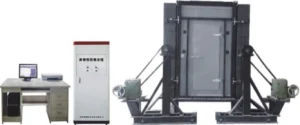
Purpose: Accelerated weathering resistance testing for External Thermal Insulation Composite Systems (ETICS).
Applicable Standards: JG 429, JGJ 144, JG 149, JG 158, JGJ 253
Key Specifications:
Air Temperature: Range: -25°C to +75°C; Control Precision: < ±0.3°C of target.
Water Temperature: 15 ± 2°C.
Relative Humidity: Range: 20% – 100% RH (±3%).
Water Spray Flow: 0 – 2000 L/h.
Power Supply: AC 380V, 28 kW.
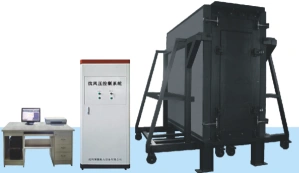
Purpose: Determines the wind load resistance (negative pressure) of external wall insulation systems.
Applicable Standards: JGJ 144
Key Specifications:
Wind Pressure Control: Range: 0 to -7000 Pa; Accuracy: ≤ ±5% of target pressure.
Cyclic Testing: Programmable number of cycles. Pulse timing control for pressurization, hold, and depressurization phases.
Power Supply: AC 380V, 21 kW. Requires an air compressor (0.4-0.8 MPa).
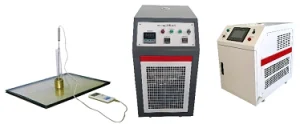
Purpose: Measures the dew point temperature and evaluates the seal integrity of insulated glass units (IGUs).
Standards: GB/T 11944, GB 50411
Key Specifications:
Model | JSW-LD-B | JSW-LD-Y | JSW-LD-F |
Readout/Display Type | Analog Meter | Analog Meter | Touchscreen |
Cooling Method | Dry Ice | Cascade Compressor | Cascade Compressor |
Minimum Temperature | -80°C | -65°C | -65°C |
Power Supply | Battery | AC 220V, 1.5 kW | AC 220V, 1.5 kW |
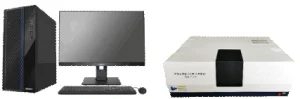
Purpose: Comprehensive optical and solar property testing for architectural glass. Optionally compatible with reflective thermal insulation coatings.
Test Items: Visible light transmittance/reflectance; Solar direct transmittance/ reflectance/ absorptance, total solar transmittance; SHGC; UV transmittance/reflectance. Optional: Solar/NIR reflectance of coatings, and changes after soiling or aging.
Standards: GB/T 2680, ISO 9050, JGJ/T 151, JG/T 235 (optional).
Key Specifications:
Measurement Range: 0% – 100%.
Wavelength Range: 250 – 2800 nm (usable: 300-2500 nm).
Accuracy: Wavelength ±0.5nm (UV/VIS) / ±4nm (NIR).
Integrating Sphere: Φ60 mm, high diffuse reflectance.
Geometry: 5° (reflection), 0° (transmission).
Power: 220V AC, 500W.
Dimensions: ~800 × 600 × 280 mm.
Purpose: Determines the U-value (thermal transmittance) of insulated glass using the Guarded Hot Plate method.
Standards: GB/T 22476.
Key Specifications:
Model | JSW-CR-A | JSW-CR-B |
Test Configuration | Dual Specimens 800×800 (mm) | Single Specimen 800×800 (mm) |
Specimen Thickness | Up to ~100 mm | |
Hot Plate Temperature | 17.5°C | |
Cold Plate Temperature | 2.5°C | |
Measurement Accuracy | ±2% | |
Power Supply | AC 220V, 5 kW | AC 220V, 8.5 kW |
Dimensions (L × W × H) | 1720 × 1280 × 2090 (mm) | 1460 × 1250 × 2015 (mm) |
Weight | 620 kg | 620 kg |
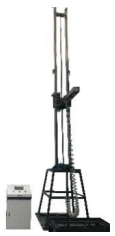
Purpose: Performs ball-drop impact and headform impact tests.
Standards: GB 15763.2.
Key Specifications:
Drop Height: 1000 – 6000 mm (adjustable).
Control: Touchscreen.
Impactors: Steel balls (227g, 1040g) and 10 kg headform.
Frame Size: ~6.9 × 2.8 × 1.5 m.
Power: 220V / 380V, 1.5 kW.
Building Doors, Windows & Curtain Walls Testing Equipment can simulate real-world environmental conditions to measure performance.
Airtightness/ Watertightness/ Wind Resistance: A sealed chamber applies controlled air pressure and water spray to the test specimen while measuring air leakage, water penetration, and deformation.
Thermal Insulation: The “hot box-cold box” method places the sample between two temperature-controlled spaces. The heat required to maintain a temperature difference is used to calculate the U-value.
Sound Insulation: Sound is generated in a source room, and the reduction in sound pressure level passing through the specimen is measured in a receiving room.
Mechanical Durability: Robotic arms or actuators automatically open, close, and lock doors/windows repeatedly to test hardware lifespan.
Building Wall Envelope Systems can evaluate wall system performance through steady-state heat transfer and environmental simulation.
Thermal Transmittance (U-value): The guarded hot box method places the wall between hot and cold chambers. The heating power required to maintain a stable temperature difference is measured to calculate thermal resistance.
Weathering & Wind Load Resistance: Specimens undergo accelerated aging cycles (temperature, humidity, UV, water spray). Wind resistance is tested by applying controlled negative pressure to check deformation and failure limits.
Glass Testing Equipment can analyze glass performance using optical spectroscopy, steady-state heat flow, and mechanical impact principles.
Optical & Solar Properties: A spectrophotometer measures transmission, reflection, and absorption across light wavelengths to calculate visible light transmittance and solar heat gain coefficient (SHGC).
Thermal Transmittance (U-value): The guarded hot plate method sandwiches glass between temperature-controlled plates. The heating power required to maintain a temperature gradient determines the U-value.
Dew Point: A cold probe cools the glass surface locally; optical sensors detect condensation to assess seal integrity.
Impact Resistance: A standardized impactor (steel ball or shot bag) is dropped from a specified height to test breakage behavior and safety performance.
 English
  Spanish
  Russian