
Ring Stiffness, Ring Flexibility testing
As to ISO 9969 or ASTM D2412, initial ring stiffness or ring stiffness characterizes the resistance of a pipe section to radial compressive forces. The measurement occurs at low deformations of 3%. As to ISO 13968, it describes the ability of a pipe to withstand deformation without undergoing structural damage. The test arrangement is similar to the test arrangement for measuring ring stiffness, however deformations of 30% are applied.
Ring Stiffness calculation
A ring stiffness test machine calculates ring stiffness by measuring the radial force and vertical deflection of a pipe sample under controlled compression, then applying a standard formula to compute the stiffness value.
The machine records two key values in real time:
– Force (F): Measured by a load cell (units: kN).
– Deflection (ΔY): Measured by a displacement sensor (units: m).
Calculation is based on the force at 3% diametric deflection (ΔY = 0.03 d, where d is the pipe diameter).
Formula: S≈F/(ΔY*L)
- S = ring stiffness (kN/m²)
- F = force at 3% deflection (kN)
- ΔY = vertical deflection (m)
- d = pipe inner diameter (m)
- L = effective length of the sample (m)
Testing procedure (to ISO 9969)
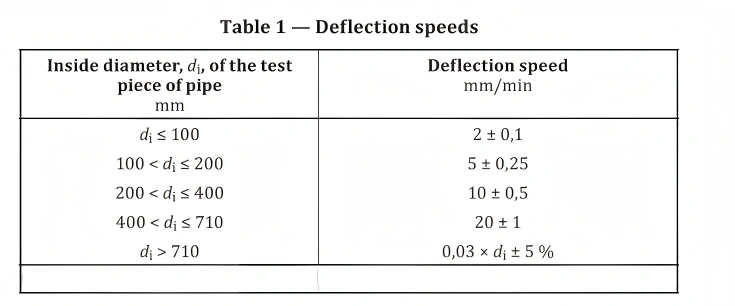
Compressive testing machine, capable of a constant rate of cross-head movement, via a pair of parallel plates, as appropriate to the nominal diameter of the pipe in conformance with Table1 with sufficient force and travel to produce the specified diametric deflection.
NOTE:
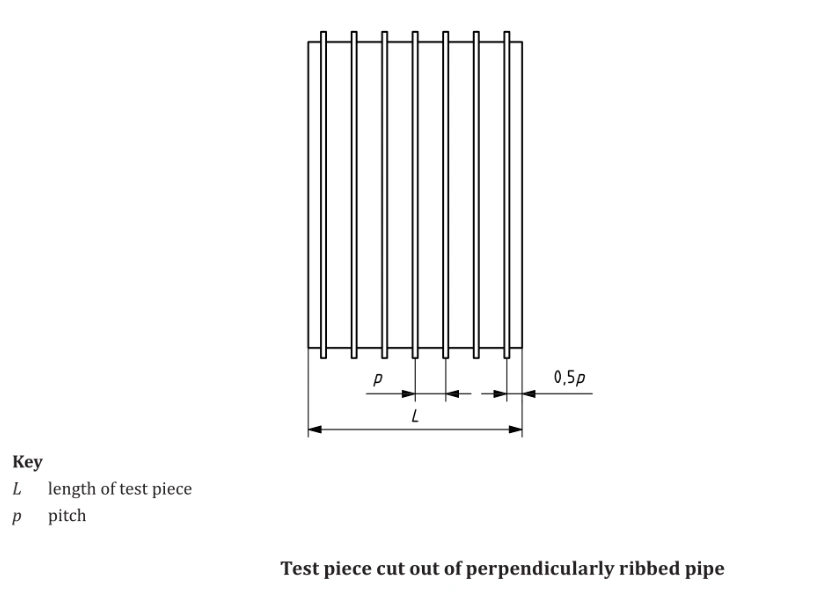
Structured wall pipes with perpendicular ribs, corrugations or other regular structures shall be cut such that each test piece contains a whole number of ribs, corrugations or other structures. The cuts shall be made at the mid point between the ribs, corrugations or other structures.
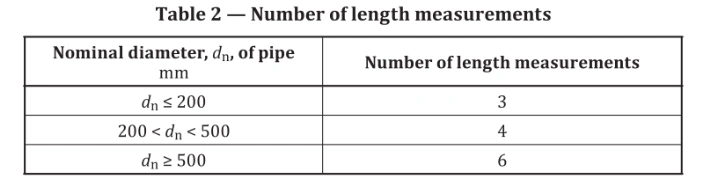
The length of the test pieces shall be the minimum whole number of ribs, corrugations or other structures resulting in a length of 290mm or greater or, for pipes greater than 1500mm, 0.2dn or greater.
Ring flexibility to DIN EN ISO 13968
It describes the ability of a pipe to withstand deformation without undergoing structural damage. The measurement is performed in the same test arrangement as for ring stiffness. According to ISO 13968, the test is run until the pipe fails or until deformation of 30% of the outer diameter of the pipe is reached. The results of the test are maximum values of force and deformation, or force and deformation values in which a damage criterion defined in the standard occurs for the first time.