
The coefficients of static/dynamic friction are measured, which indicate the force required to move two surfaces parallel to each other that are loaded with a weight. In a word, the lower the coefficient of friction, the easier the movement. The coefficients of friction are influenced by many factors. These include the materials of the surfaces, roughness, presence of lubricants, ambient temperature and the humidity, etc
Coefficient of static friction: μs = As/B
Coefficient of dynamic friction: μk = Ak/B
| Abbreviation | Unit | Name | Short description |
| μs | Static coefficient of friction | Indicates how much force is required to set two materials in motion. A high μS value means that it is difficult to move the materials; The static coefficient of friction is calculated using the initial peak value of the tensile force on the sled. | |
| As | g | Static frictional force | As is the mass force in grams required to start the slide movement. |
| µk | Kinetic coefficient of friction | Indicates how much force is required to keep two materials moving after they have already been set in motion. This value may differ from μS and is often lower. The kinetic coefficient of friction (sliding friction) is calculated from the average value of the tensile force on the sled over a specified sliding distance. | |
| Ak | N | Kinetic frictional force | Ak is the average mass force in grams recorded during the uniform movement of the carriage. |
| B | g | Mass of the carriage in grams |
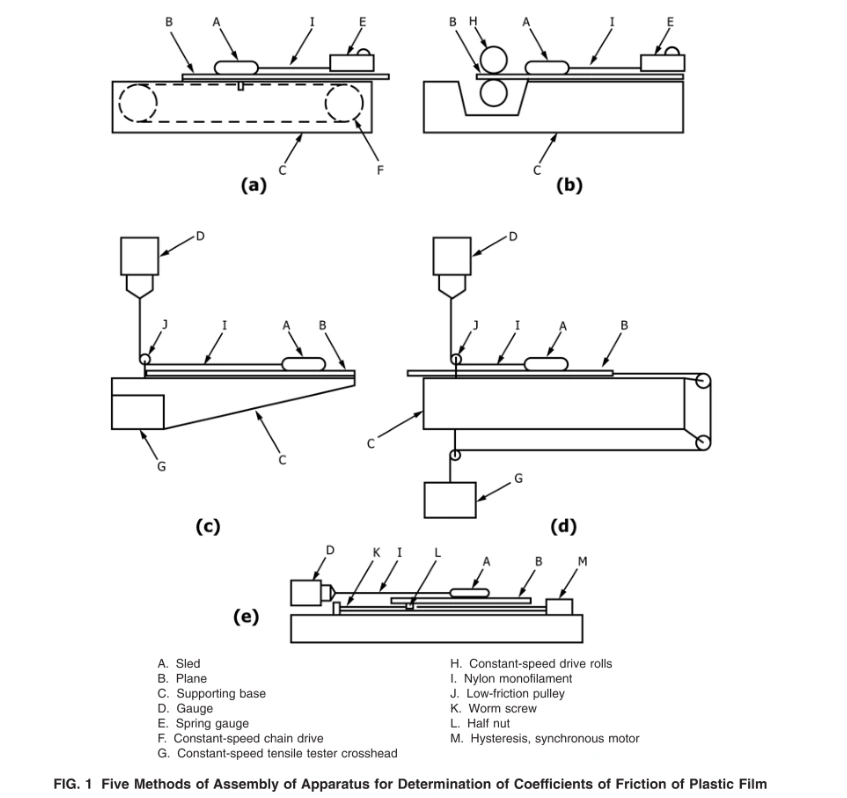
Specimen that is attached to the plane is defined with measurements of 250mm*130mm (10 inches*5 inches). The film specimen mounted on the sled must be cut to an approximately 120 mm(4.5 in.) square and shall not exceed a specimen thickness of 0.254mm (according to standard terminology for films defined in ASTM D883).
Sheeting specimens shall be flat and free of warpage. Edges of specimens shall be rounded smooth.
Five specimens shall be tested for each sample unless otherwise specified. (Warning-Extreme care is needed in handling the specimens. Contamination of the test surface by dust, lint,finger prints, or any foreign matter may change the surface characteristics of the specimens.)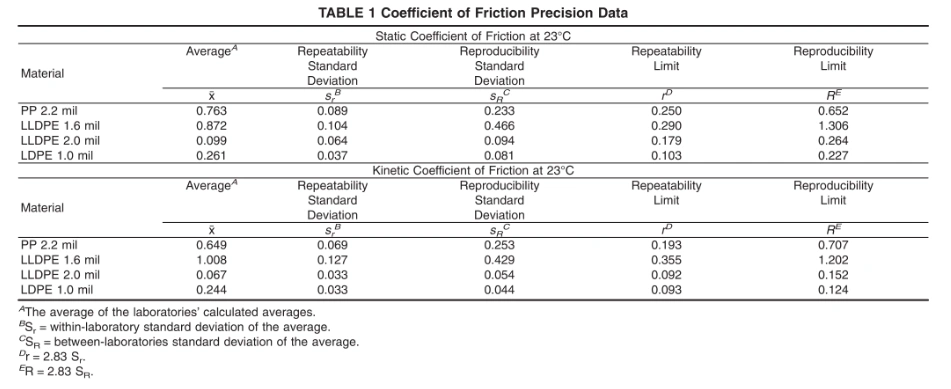
 Spanish
  English
  Russian