
Analizador de Elementos
Analizador elemental
Espectrofotómetro de absorción atómica | Analizador de mercurio |
Robot Automático de Digestión de Grafito
INICIO>>Analizador de Elementos>>Carbon and sulphur analyser
CS3500 Carbon and sulphur analyser
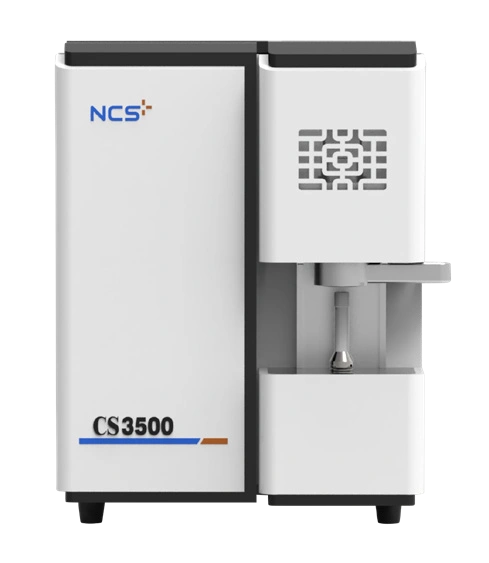
The Carbon and Sulfur Analyzer (CS3500 series) by SINOTEST is a high-precision analytical instrument designed for the simultaneous and rapid determination of carbon and sulfur content in solid materials. Specifically, it employs high-frequency induction combustion combined with advanced infrared detection technology to achieve accurate quantification across a wide analytical range—from trace levels (1 ppm) to high concentrations. Furthermore, this carbon sulfur analyzer is ideally suited for the steel, powder metallurgy, non-ferrous metals, magnetic materials, new energy, and third-party testing industries, where reliable elemental analysis is essential for process control and quality assurance.
In terms of detailed application, the CS3500 carbon and sulfur analyzer enables simultaneous, rapid analysis of carbon and sulfur in a wide variety of solid materials—including steel and its alloys, non-ferrous metals, powder metallurgy products, rare earths, NdFeB, and ores. In addition, the instrument is fully compliant with ASTM E1019 for carbon and sulfur determination in steel and alloys. Consequently, this elemental carbon sulfur analyzer provides a reliable, high-throughput solution for quality control and research applications requiring precise compositional data.
MODELOS DISPONIBLES
Especificación técnica detallada
The CS3500 Series carbon and sulfur analyzer is ideally suited to provide precise, simultaneous determination of carbon and sulfur in primary steels, ores, finished metals, ceramics, and other inorganic materials.
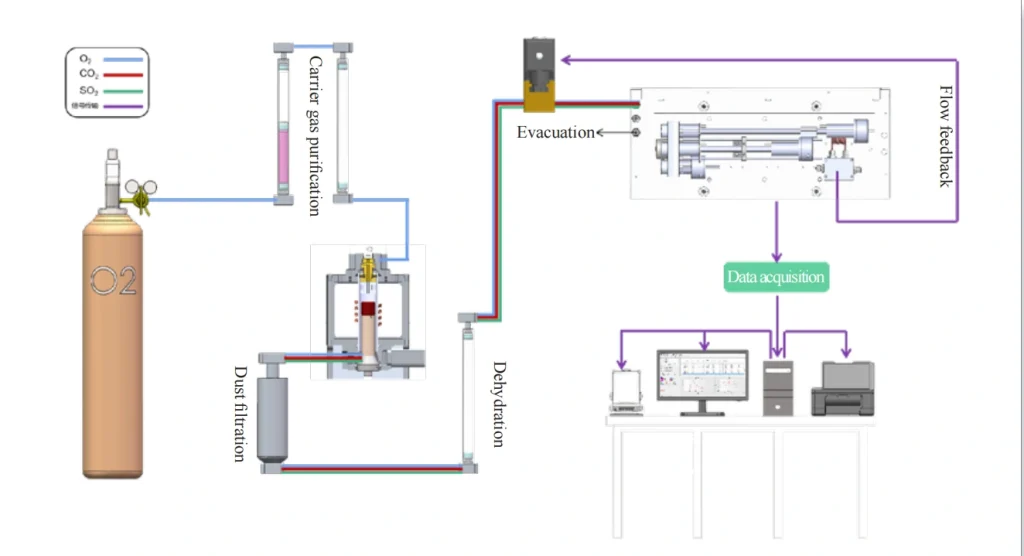
In a typical analysis, the user places a sample weighing 0.5 to 1.0 g into a crucible together with approximately 1.5 g of tungsten accelerator. Subsequently, the system positions the crucible on a pedestal and drives it into the induction furnace via a pneumatic system. Once inside, the sample undergoes complete combustion in a stream of pure oxygen. During this combustion process, the carbon content oxidizes to CO₂ while the sulfur content converts to SO₂.
After combustion, a filter system traps dust and other particulates. The CO₂ and SO₂ gases then flow from the furnace in the oxygen carrier gas to the infrared absorption detectors. At this stage, the detectors determine the actual gas concentrations and transmit the data to the PC, where the operating software calculates the final results by integrating the entire signal peaks.
To ensure accuracy, the user establishes a calibration database with known reference samples, providing the necessary analytical precision and repeatability. Finally, the pneumatic system drives the burned crucible out of the furnace, and the operator disposes of it. In addition, clean oxygen purges the furnace and gas flow system after each analysis to prevent any interference—known as the memory effect—between individual samples.
The CS3500 carbon and sulfur analyzer delivers exceptional analytical range and precision. For a standard 500 mg sample, the low carbon range spans from 1 ppm to 0.1%, while the high carbon range covers 0.1% to 5%. In the case of sulfur, the low sulfur range extends from 1 ppm to 0.3%, and the high sulfur range—using a reduced 150 mg sample—reaches from 0.3% to 30%. Notably, users can extend the analysis range to 100% by adjusting the sample weight, and can customize a high sulfur absorption tank according to specific requirements.
In terms of accuracy and sensitivity, the instrument achieves exceptional results. Low carbon measurements attain 1 ppm or an RSD ≤ 1%, while high carbon measurements achieve an RSD ≤ 0.5%. For sulfur, low sulfur measurements reach 1.5 ppm or an RSD ≤ 1.5%, and high sulfur measurements maintain an RSD ≤ 1.5%. Furthermore, the system offers a sensitivity of 0.01 ppm, ensuring reliable detection even at ultra‑trace levels.
As for operational parameters, each analysis is completed within 30 to 40 seconds. The recommended sample weight ranges from 0.1 g to 0.5 g, with the flexibility to adjust according to the expected content. The high‑frequency induction furnace operates at 18 MHz with a power rating of 2.7 kVA.
Finally, regarding physical specifications and installation requirements, the instrument measures 55 cm in width, 77 cm in height, and 76 cm in depth, with a total weight of 100 kg. The required power supply is 220 VAC ± 10% at 50 ± 1 Hz, with a minimum current rating of 16 A. The carrier gas is oxygen with a purity of 99.9%.
The induction furnace ensures fast and complete combustion at temperatures reaching approximately 2200 °C. Moreover, its robust design guarantees a long service life with minimal maintenance. Operating at 18.5 MHz and 2.2 kVA, it provides a versatile combustion platform suitable for a wide range of materials. In addition, the unique furnace design effectively reduces splattering, and an easy‑to‑clean metal filter traps the combustion dust, simplifying routine maintenance.
Following combustion, the specially developed IR detector—featuring up to four independent absorption units—delivers the wide analytical range and high precision required for demanding applications. Furthermore, this reliable design ensures long‑term stability and very low maintenance. High‑technology detectors and precision interference filters provide the foundation for long‑term calibration stability, while a built‑in temperature controller ensures the detector system remains independent from environmental conditions. Notably, the system employs a solid‑state pyroelectric detector manufactured in Germany.
In terms of core technology highlights, the CS3500 carbon and sulfur analyzer incorporates a comprehensive suite of advanced features. Specifically, it provides flexible heating power control, advanced temperature control, and precise gas flow control. Additionally, unique software capabilities enable linearized IR signal data processing, helping to achieve internationally advanced analytical precision. Furthermore, the analyzer integrates high‑reliability electronic components, comprehensive diagnostic functions, redundancy protection against meltdown, and a sealed gas passage with zero dead volume. Consequently, this elemental carbon sulfur analyzer combines robust hardware engineering with intelligent software control to deliver consistent, high‑precision results across the full analytical range.
▪FOB
▪CIF
▪Paquete: Caja de madera
 Spanish
  English
  Russian